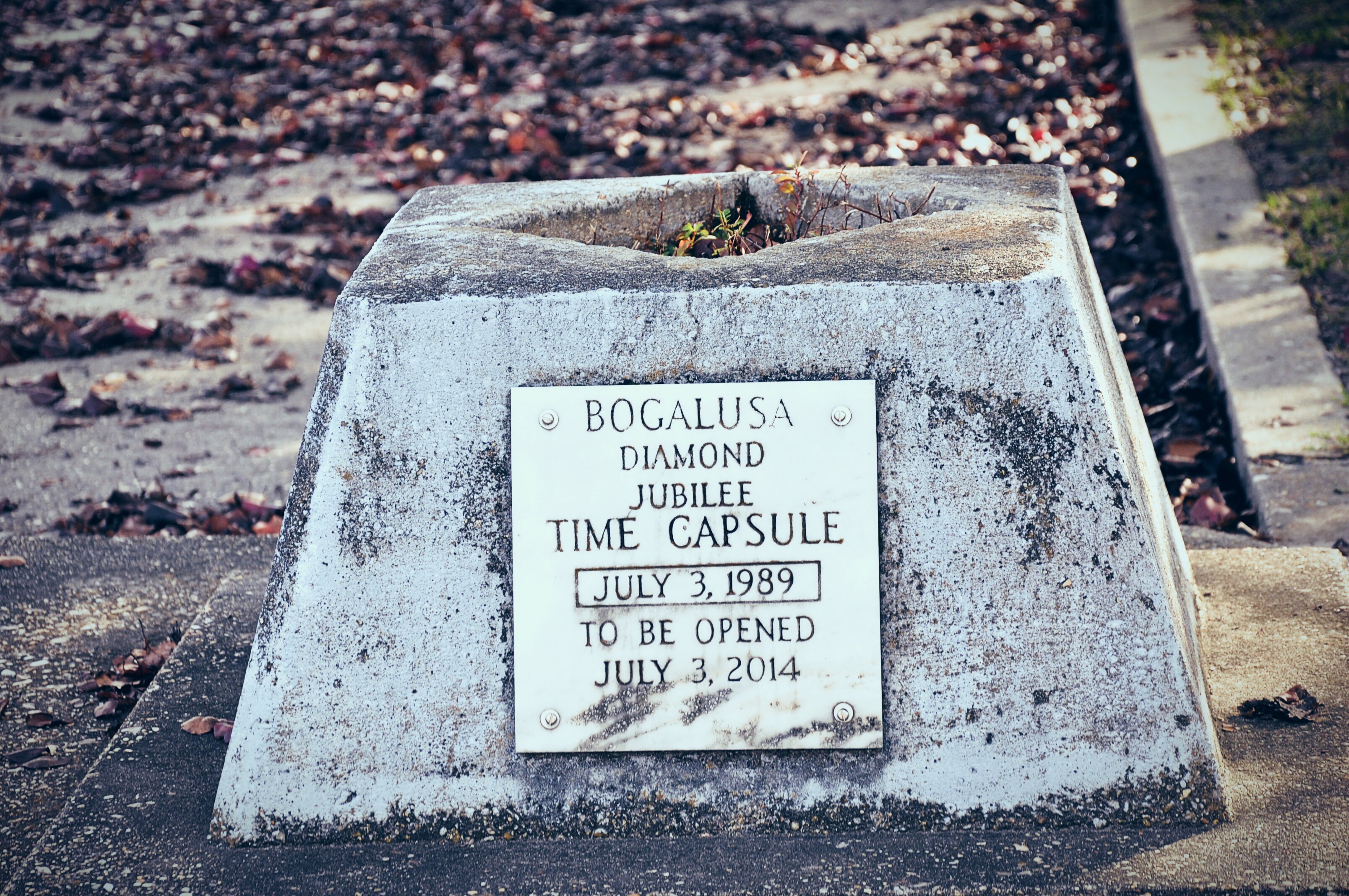
Bogalusa Diamond Jubilee Time Capsule | Source
How are we preparing for the Long Web?

What will the Internet look like in 2036? 2046? These are questions that are near-impossible to answer. But that doesn't mean we shouldn't try. To be fair, this question is more philosophical than logistical... but I can't help myself.
One of the principles of the IndieWeb is the Long Web[1], or Longevity. Funnily enough, the article on the concept is a stub, so consider this my contribution.
In a weird way, people and companies are kind of just winging it and building for today. Most in the field are trendhoppers and fair weather participants. In the past there's been AngularJS, Backbone.js, Ember.js, Meteor.js, Gatsby, Apache Cordova, just to name a few. Websites are created with current hottest frameworks for whatever iteration of CSS and JavaScript works with Chrome's Blink Rendering Engine and V8 JavaScript Engine at any given moment. You'll have to pay a pretty penny for updates and maintenance.
That said, there are niche platforms that are focusing on existing forever. In 2013, after Twitter shut down Posterous, the original cofounders Garry Tan and Brett Gibson launched Posthaven, designed to never ever shut down. Sure, the blog hasn't been updated since 2016, but the fact it's still online ten years beyond that is a good sign, right?
On the more expensive end of the spectrum, Automattic launched their WordPress.com 100-Year Plan in 2025, a commitment to keep your site online for a century, complete with trust accounts, mirrored data centers, and active snapshot backups in the Internet Archive's Wayback Machine. It only costs $38,000, a great deal! It's an admirable (if audacious) idea, but it does raise the obvious question: what happens to the plan if Automattic itself doesn't make it to 2125? They've tried to answer this with contingency protocols, but the honest answer is nobody really knows.
Speaking of, there are certain metrics we can look at that are set in stone. For example, the maximum amount of time you can renew a domain name (which I just wrote about) (without paying Automattic thousands of dollars) for at a time is ten years. And so, because of that, I've decided to renew https://brennan.day for the next ten years on Porkbun. I'll own this domain until I'm at least 40-years-old, assuming nothing in the chain of logistics collapses by then. Wow.
Hosting though? That's a lot less uncertain for me. I'm currently using Netlify's free plan (which is now in legacy mode already). Now, I am extremely thankful Netlify has free hosting, because I currently have over two dozen sites online with the platform, but this is obviously volatile and ephemeral. I would have a much more certain bet if I was paying for a web host like Hertzner with Bunny CDN, but that would be far more expensive (relative to what I'm paying right now, which is nothing).
Of course, paying doesn't actually guarantee anything, either. Just a few weeks ago Heroku announced that "Enterprise Account contracts will no longer be offered to new customers", instead beginning to focus on maintenance and stability. The writing is on the wall.
The Hardware
What about running your site on your own bare metal instead of a VPS? Well, I wrote about permacomputing in the apocalypse, and while it might seem more reliable, the truth is that hardware doesn't last forever.
- Consumer-grade hard drives are rated for around three to five years of continuous use before failure rates climb sharply. SSDs fare somewhat better in ideal conditions, but have a finite number of write cycles baked in at the hardware level.
- Capacitors on motherboards, the humble components stabilizing voltage, are known to fail after fifteen or twenty years, sometimes catastrophically.
- Even if your hardware holds up, connector standards don't: a drive from 2005 using IDE or SATA I might simply have no modern machine to plug into by 2035.
Repairability offers some hope here; projects like the Open Compute Project and the broader right-to-repair movement are pushing for modular, repairable hardware that outlasts the planned obsolescence cycle. But even the most optimistic estimate puts a well-maintained home server at perhaps twenty years before something critical becomes either unfixable or irreplaceable.
There are just certain aspects of longevity that aren't in our hands.
The Numbers Are Not Encouraging
Before we can talk about how to build for the Long Web, it's worth sitting with how things are:
- A 2024 Pew Research Center study found that 25% of all web pages that existed between 2013 and 2023 are no longer accessible. For pages from 2013 specifically, that number climbs to 38%.
- An Ahrefs study found that over 66.5% of links published in the last nine years are now dead.
- According to the same Pew research, 54% of English Wikipedia articles contain at least one dead link in their references, and 23% of links in news articles point to URLs that no longer exist.
- Nearly 20% of posts on X/Twitter are no longer publicly visible.
- In academia and law, the rot is especially corrosive: half of all U.S. Supreme Court opinions contain dead links, meaning the very citations that legal reasoning depends on are quietly vanishing.
This phenomenon is link rot, or more broadly, digital decay. This isn't a future problem. It's happening right now, steadily and without fanfare. Pages disappear when servers go offline. Domains expire and get squatted. Companies fold and take their entire archives with them. A generation of niche knowledge: the Geocities pages, the phpBB forums, the archived mailing lists. Mostly gone.
The Long Now Foundation's Alexander Rose wrote in the long run of multiple generations, he suspects "next to nothing" of the format in which content was delivered will be recognizable, even if the raw data survives. Surviving isn't the same as being legible.
The digital dark ages has been circulating among archivists and information scientists since the late 1990s. In 2018, a data preservation director at Google noted that we may end up knowing less about the early 21st century than we do about the early 20th, as early 20th century records were made on paper, while so much of what we create now is born digital and dies digital, without ever becoming physical.
All of this writing. All of these photographs. All of these communities. Less legible to a historian in 2125 than a handwritten letter from 1925.
Design
Jeff Huang provides some solid design principles for us to be mindful of. His seven-point manifesto is worth reading in full, but the distilled spirit of it is this: the more complex a site is, the more likely it is to break. He argues for:
- Return to vanilla HTML and CSS rather than leaning on a tower of JavaScript dependencies. Every library included is a potential failure point.
- Avoiding hotlinking to external stylesheets or scripts that can vanish overnight (this includes Google Fonts, CDN-hosted JavaScript, and embedded analytics).
- Preferring a single long page over a sprawling multi-page architecture. One file is easier to maintain and archive than a system of interlinking templates.
- Sticking with native system fonts rather than calling out to a web font CDN.
- Obsessively compressing images and keeping total page size small. Lighter is more survivable.
- Setting up redundant uptime monitoring because you want two independent alerts, not one.
A Balancing Act
There are other assumptions we can make, too. For instance, a static site is inherently more robust for longevity than a dynamic site. A text-only site is more robust for longevity than a media-rich site.
There are always trade-offs. While I love the current design of my personal site, I can absolutely see certain aspects of the stylesheets or JavaScript progressive enhancement breaking over time. Meanwhile, something much more simple and plain like the IndiePaper blog theme I made, built in Hugo (an SSG with no dependencies), has a much better chance of functioning for a lot longer.
I think an ideal solution would be to have two sites: Your personal site that is creative and personalized to your heart's content, and a brutalist archive version designed to last as long as possible. Leave a reminder behind so people know what to do with the work you've done, at least for the relief of your own ego.
Other Formats
Ben Roberts has AIM chat logs dating back to 2002, preserved through multiple filesystem and OS changes specifically because they were plain HTML files, while older emails stored in proprietary software formats were lost forever.
Joel Dueck wrote in 2018 about the fragility of web pages compared to books. The container matters as much as the content. Plain text with semantic HTML is the closest thing we have to a universal, forward-compatible format.
Tim Berners-Lee put it simply in 1998: cool URIs don't change and the same logic extends to the documents those URIs serve.
Openness and the Long Game
Jeremy Keith's 2008 talk "The Long Web" argues that the qualities that make a format good for the long term (simplicity, openness, standardisation) are the same qualities that make it good for accessibility, portability, and the web's general health today. They aren't sacrifices you make for the sake of some abstract future historian. They're just good practice that happen to also be good ethics.
DRM-laden formats are effectively doomed, as Keith pointed out seventeen years ago. The data shuts down as soon as the provider does. Every user who bought a song from Virgin Digital or a video from an early Google store found that out the hard way. Closed formats are zombie formats.
The Archivists
It would be deeply unfair to talk about the Long Web without acknowledging the people who are already doing the hard work of preservation without recognition and on shoestring budgets.
The Internet Archive, founded by Brewster Kahle in 1996, is the closest thing the web has to a Library of Alexandria. The Wayback Machine has over 800 billion web pages stored and captures around 650 million more each day. It preserves books, television, radio, software, government records, and an enormous amount of cultural ephemera that would otherwise vanish.
The scale is impossible to comprehend. The Archive currently holds well over 100 petabytes of data. One petabyte is 1,024 terabytes. This institution, which the entire Internet depends on, runs as a nonprofit on a donation model. We should talk about that more.
In the early Middle Ages, after the fall of Rome, anonymous Irish monks on remote island outposts in the North Atlantic spent their lives copying manuscripts by hand, preserving the great works of ancient Greece and Rome for future generations who didn't yet exist. We know almost nothing about these monks individually. Every now and then one of them would scribble something in the margin like My hand is weary with writing or Pleasant is the glint of the sun today upon these margins.
We are those monks. And the IndieWeb is, among other things, an archipelago of islands in the North Atlantic, keeping the lights on.
To Remember, or to Forget?
Theresa O'Connor wrote in 2024 how not everything should be preserved, and the act of choosing what to keep is itself a meaningful act. Curation requires reflection, intention, and vulnerability. O'Connor, drawing on Emily Gorcenski's essay on curating her own Twitter archive, notes the tension between the inclination to archive everything and the reasons someone might want to let certain things go. Trans people, for example, whose relationship to their pre-transition selves is complicated and deeply personal.
What are we preserving, and for whom? Are we preserving our authentic selves? The self we publish, both online and in the physical world, is the only part of us that will survive past our lifetimes and the lifetimes of those who know us.
The Threat of Fragmentation
Longevity is political. The DNS Research Federation's 2023 paper on the Internet in twenty years time outlines three plausible futures for the network:
- A semi-fragmented Internet where specialised networks co-exist alongside the traditional web, creating fast lanes and new digital divides along socioeconomic lines.
- A fully fragmented Internet split along national and ideological lines, where interoperability is no longer guaranteed and the free flow of information across borders becomes increasingly constrained.
- A strengthened global Internet achieved through renewed multilateral collaboration, where human rights considerations are baked into new standards from the start.
I'm sure I don't need to tell you that the third scenario is the least likely.
The Community Memory Crisis
There's a real grief embedded in this too. Joan Westenberg wrote recently about the death of community memory online. Entire ecosystems of shared knowledge and conversation are disappearing with an expired credit card and an unmaintained server. Forums are replaced with real-time chat platforms like Slack and Discord, and chat is architecturally designed to be forgotten, optimized for the present moment rather than future retrieval.
Important decisions, carefully built knowledge, hard-won community norms all disappear after a few weeks.
NiwlCraft observed on Mastodon that a Facebook or Google Drive link is dead or deleted by the time you need it, while a Neocities link made by someone who may no longer be alive keeps loading just fine. The IndieWeb, for all its quirkiness and stubbornness, has accidentally built something resembling a preservation ethic because we chose formats and infrastructure that get out of their own way.
Seed Planting
In Haudenosaunee (Iroquois) law, there is a principle known as The Seven Generations, an Indigenous philosophy that requires current decisions to consider impacts and ramifications seven generations into the future, while also respecting seven generations of ancestors.
While I don't think it's possible to comprehend the Internet that far into the future (nor has it existed for more than three or four generations tops so far), I believe this aspect of longevity is extremely important to be mindful of as well.
Our legacy and contribution to the ongoing dialogue of development and design is nothing to scoff at. Websites built over twenty years ago are refound and held with reverence, and they were usually built by someone who never thought anybody would pay attention to it. We love these sacred time capsules not just out of nostalgia, but also out of the connection and humanity we find stretching far beyond our own lifetime.
What can we pass on? What can we leave behind so that the next generation of netizens and internauts aren't reinventing the social wheel once again? To paraphrase a popular musical, what seeds are we planting in the digital garden that we never get to see?
A session at IndieWeb Summit 2016 ↩︎


Comments
To comment, please sign in with your website:
Signed in as:
No comments yet. Be the first to share your thoughts!