Disability in Adventure Time

When Finn and Jake first bounded across my television screen in 2010 I was fourteen-years-old. Their world of post-apocalyptic whimsy unfolding in eleven-minute bursts of colour and sound. The Land of Ooo was a place where candy could talk, where dogs stretched like taffy. Where adolescence was both magical and monstrous.
I didn’t know that I would still be here, fourteen years later at twenty-eight, sitting cross-legged on my couch waiting for the second season of Fionna and Cake, feeling the strange vertigo of growing up alongside a cartoon character. There’s a song that plays in season six, when everything changes for Finn. Rebecca Sugar’s gentle voice carries the words like water:
Everything stays/Right where you left it/Everything stays/But it still changes/Ever so slightly/Daily and nightly/In little ways/When everything stays.
We change while staying the same. We lose parts of ourselves while remaining whole. Finn lost his arm, and in that loss, I recognized something I’d never seen in children’s animation before—a narrative that refused to reset to the status quo and that acknowledged disability as an ongoing reality rather than a temporary obstacle to overcome.
When Finn’s arm was severed in “Escape from the Citadel,” something shifted in children’s animation. Here was a protagonist whose body changed permanently, whose disability wasn’t magically cured by the next episode. The series transformed from a lighthearted adventure into a meditation on loss, on growing up, on adapting to permanent change.
As someone who has witnessed Adventure Time from its playful beginnings to its philosophical depths, I’ve been struck by how little critical attention has been paid to Adventure Time’s portrayal of disability. Beyond Holdsworth’s chapter in The Government of Disability in Dystopian Children’s Texts, there exists a near void of scholarly examination around this pivotal aspect of the series. A total missed opportunity to recognize what Adventure Time accomplished—creating a nuanced and persistent representation of disability in children’s media, and the psychological journey accompanying physical change.
The Fatalist Framework: Inevitability and Agency
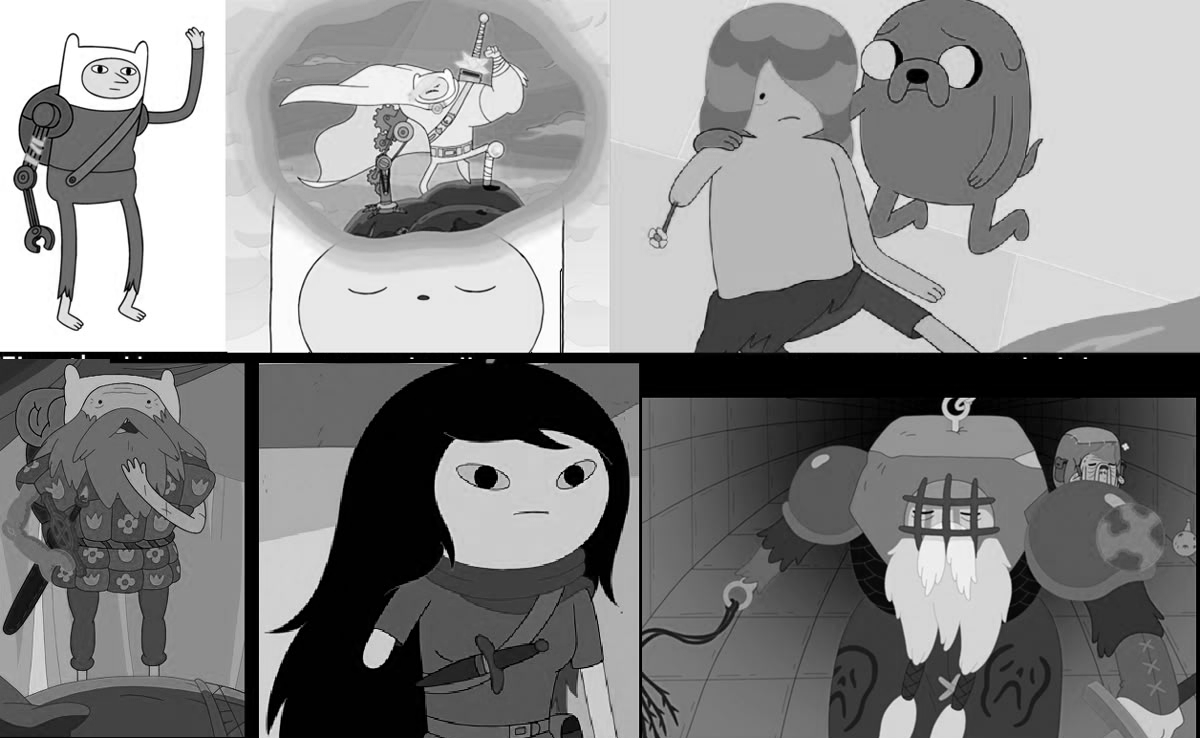
Finn’s amputation spans multiple episodes and dimensions, beginning in the fifth season finale “Escape from the Citadel,” evolving throughout the subsequent seasons. What makes this narrative arc distinctly fatalist is the recurring suggestion that this loss was predestined. Multiple alternate versions of Finn across different timelines—Farmworld Finn, Pillow World Finn, and various future projections—all lose their right arms in different ways. Repetition establishes the amputation as an event transcending individual choice or circumstance—a constant in Finn’s existence.
The series foreshadows the loss extensively before it happens, as Holdsworth notes: “Foreshadowing is evident in alternative realities or future visions with a cybernetic prosthetic which can be seen in ‘Mortal folly’ (2.24), ‘King worm’ (4.18), ‘Finn the human’ (5.01), ‘Jake the dog’ (5.02), ‘Puhoy’ (5.16), and ‘Dungeon train’ (5.36)” (135). The series frames the fatalist theme through the cosmic entity Prismo, who tells Finn point blank—“In every dimension, you lose your arm.” Paradoxically, Adventure Time does not use fatalism to deny agency but rather to explore how individuals respond to inevitable change and loss.
Trauma, Identity Formation, and the Government of Disability
The amputation serves as a powerful metaphor for adolescent trauma and the process of identity formation that follows. When Finn loses his arm while attempting to reconnect with his human father Martin (who promptly abandons him again), the physical loss intrertwines with psychological abandonment. Adolescent identity crises often stem from multiple sources of distress occurring simultaneously. Holdsworth argues that the series makes this connection explicit through the character of Shoko in “The Vault” (5.34), where we learn “Shoko reveals her parents sold her arm before abandoning her, making it the most explicit foreshadowing of Finn’s experiences in season six” (135). This establishes a pattern where “disability is connected to parental abuse and neglect” (136), creating a problematic association between disability and family trauma. The series tracks Finn’s psychological response to this loss across several stages.
- Denial and Prostheticization: Initially, Finn attempts to minimize his loss through various prosthetic replacements. “Beginning with Finn depicted with a candy prosthetic arm provided by Bubblegum, which he struggles to adjust to, with several mishaps, before the arm eventually explodes” (136). This reflects the systemic impulse to “fix” disability rather than accept it.
- Anger and Unstable Behavior: Following the denial stage, Finn manifests “a ‘telekinetic electro-emotional prosthesis’ (6.04), a phantom arm powered by his anger, and begins to build a tower into space to find his father and seek revenge” (136). Princess Bubblegum intervened, expressing concern that Finn could be “a danger to himself or others” (136).
- Depression: In “Breezy” (6.06), Finn explicitly states “I don’t feel anything” when asked about adjusting to his amputation. His body language—”walking extremely hunched over with the top half of his body dragging along the ground between his legs while singing ‘I’m lost in the darkness/What will this bring?’”—signals a deeper depression than he verbally acknowledges (138).
- Problematic “Acceptance”: Rather than showing a healthy integration of his disability into his identity, the series opts for magical regeneration in “Breezy” where “the sleeping Finn’s flower to grow into a tree which then explodes revealing a regenerated arm in place of the flower/tree”, reinforcing the problematic narrative disability must be overcome rather than accepted (139).
What emerges from Finn’s progression is both grief and commentary on how disability is governed and controlled in society. “Despite Finn’s status as a hero, audiences may be strongly positioned to agree with the extreme intervention by Bubblegum to manage and discipline Finn as a traumatised and disabled subject” (137). Disabled bodies are subject to medical and social control in the name of safety or normalization.
Objectification and the Disabled Body
A troubling aspect of Finn’s disability arc occurs in “Breezy” (6.06), where the episode explores “the problematic discourses of sexual desire, objectification, and consent concerning disabled people” (138). The character Breezy becomes obsessed with Finn’s flower (which has grown from his residual limb), touching it without permission and saying things like “Your flower feels good, yes” (138). “The fetishisation of Finn’s body and repeated unwanted touching throughout the episode are framed as comedic but nonetheless normalise attitudes of sexual harassment and objectification of the disabled body,” alluding what disability scholar Alison Kafer describes as “the desire and disgust dynamic that pervades devotee discourse”, where parts of disabled bodies become objects of fascination detached from the person.
Finn attemps to overcome his depression through hypersexual behavior, “trying to kiss as many princesses as he can” (139), reinforcing harmful stereotypes about disability and sexuality—either disabled people are objects of unwanted fetishistic attention or they must prove their worth through sexual conquest.
Visual and Narrative Significance of Prosthetics
The visual representation of Finn’s amputation and subsequent prosthetics carries significant symbolic weight. The series of arms that replace his lost limb—flower, grass sword, mechanical, and eventually the grass arm—each represent different approaches to trauma:
- The flower arm is fragility and natural adaptation proving insufficient for Finn
- The telekinetic arm manifests his rage and desire for revenge
- The mechanical arm designed by Princess Bubblegum suggests transhuman compensation for natural loss
The series continually returns to prostheticization rather than allowing Finn to exist without an arm for extended periods. As Valentín notes, “it feels frustrating that the writers chose to keep Finn disabled but make his disability invisible in a media landscape where so few children who are disabled get to see characters that look and live like them” (140). There’s discomfort with showing a non-normative body in children’s animation, even in a world populated by candy people, talking animals, and other non-human entities.
Comparison with Other Media Representations
Finn’s amputation and subsequent character development stand in stark contrast to typical representations of disability in children’s media. Unlike characters who are introduced with disabilities as defining character traits, Finn experiences disability as a transformative event within an established character arc. This approach more accurately reflects how many people experience disability—as a life change rather than a fixed identity from birth.
However, the series’ handling of disability remains problematic in several ways, “the quick prostheticisation of Finn speaks to Adventure Time’s reluctance to treat physical disability as a worthy and substantial subject matter, instead choosing to write it into his characterisation but only with negative associations” (140). The series consistently frames disability as something to be overcome, fixed, or magically healed rather than integrated into one’s identity.
Ambivalence reflects broader cultural tensions around disability representation. While “there has long been a sense within the disability rights movement and amongst disability scholars that representation matters” (Sandell and Dodd, qtd. in Holdsworth 130), simply including more representation doesn’t necessarily challenge problematic narratives. Indeed, some have argued that “the sensibilities that led to the demise of [negative] images … have paved the way for alternatives that … have done little to lend support to the reconceptualization of disability fought for by the disability rights movement” (130).
Everything Stays, Everything Changes
My body has changed since I first watched Finn and Jake’s adventures unfold. Pills line my nightstand now—small chemical promises for mental balance, neurological focus, a temporarily steady heartbeat. Beta blockers for my heart condition leave me weak some days, my energy ebbing like tide pools in the afternoon sun.
I find myself, like Finn, navigating a body familiar and foreign. I watch him adapt to his phantom limb, his flower arm, his mechanical replacements, and recognize something of my own daily negotiations with capability and limitation. The exhaustion that comes without warning, the calculations before each staircase, each meeting, each adventure. What Adventure Time offered wasn’t perfection in disability representation, but rather a starting point—a question mark where most shows provide only periods. Finn loses his arm across every dimension. Our bodies change, inevitably, permanently. Certain changes arrive with dramatic suddenness like Finn’s amputation; others creep in gradually like my heart condition. What follows is what matters.
Martin, Finn’s father, embraces nihilism when faced with loss—choosing escape, abandonment, denial of responsibility. Finn initially flirts with this path through his tower of rage but ultimately chooses something closer to existentialism—finding meaning not in what happens to him but in how he responds.
The series’ persistent return to prostheticization—its reluctance to allow Finn to exist without replacement arms—reveals our culture’s discomfort with non-normative bodies. The series gives with one hand what it takes with another. I wonder what children learn from stories accepting disability as neither tragedy nor triumph but simply as experience—another way of moving through the world. What if Finn had remained one-armed for more than a few episodes? What if his disability had been treated as normal rather than an obstacle to overcome? What narratives might children build from such imaginings?
When I watch the show now, I see the seeds of a more liberatory future in its contradictions. The series takes the unprecedented step of making its protagonist permanently disabled but can’t fully imagine what that means. It speaks to our cultural moment—both more aware and still struggling to reckon with bodily difference.
Yes, everything stays, but it changes—our bodies, our stories, our understanding. We are versions of ourselves across multiple dimensions, multiple timelines. Somewhere, there’s a version of Finn who fully inhabits his disability without magical remedies. Somewhere, there’s a world where children learn early accessibility is justice. We create that world partly through imagination, through stories that make visible what has been hidden.
Adventure Time’s incomplete attempt matters because it creates space for more complete tellings. Each story that acknowledges disability as ordinary human variation rather than metaphorical device brings us closer to a reality where children understand accessibility as fundamental rather than additional.
My body will continue changing. The medications might increase, the fatigue might deepen. But like Finn, I find meaning not in what happens but in how I respond—in the stories I choose to tell, in the worlds I help to imagine. When everything stays but still changes, we get to decide what those changes mean.
What Adventure Time offers isn’t a perfect representation but a starting point for conversation—about fatalism and choice, about bodies and adaptation, about how we govern disability and how we might instead liberate it, inviting us to imagine more radical possibilities for understanding difference, for creating worlds where everyone belongs exactly as they are.
And isn’t that what adventure really means? Not conquering new territories but learning new ways to see what’s already there, lying upside down, waiting to be turned around.
Works Cited
Holdsworth, Dylan. “‘This Magic Keeps Me Alive, but It’s Making Me Crazy!’: Amputation, Madness, and Control in Adventure Time (2009–2018).” The Government of Disability in Dystopian Children’s Texts, Springer Nature Switzerland, 2024, pp. 129–140.
Comments
To comment, please sign in with your website:
How it works: Your website needs to support IndieAuth. GitHub profiles work out of the box. You can also use IndieAuth.com to authenticate via GitLab, Codeberg, email, or PGP. Setup instructions.
Signed in as:
No comments yet. Be the first to share your thoughts!