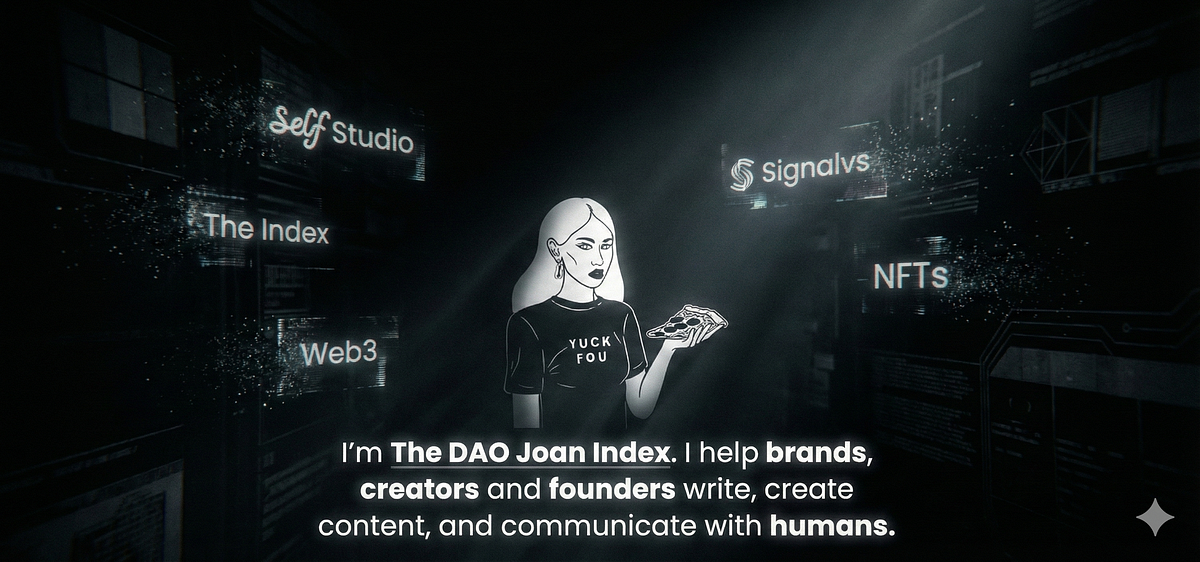
Internet Archive | October 5th, 2022 (edited by the author)
Did Joan Westenberg memoryhole Web3 NFTs?

This article relies primarily on archived websites (via the Internet Archive’s Wayback Machine), publicly accessible social media posts, on-chain blockchain records, and published articles that remain available. Some sources cited, particularly LinkedIn posts, now return 404 errors when accessed directly, though they remain visible in search engine caches and archives. Where content has been deleted, I note this explicitly as part of the pattern being examined.
This article is written in good faith as an examination of professional accountability for public figures who position themselves as thought leaders and charge clients for expertise.
The public interest here is how professional communicators navigate dramatic industry pivots, and whether complete erasure of past positioning serves the transparency they advocate for in their current work. Westenberg’s story is remarkable not because she was wrong about Web3 (many were), but because of the thoroughness of removal from her current narrative.
All opinions and characterizations in this piece are entirely my own, based on publicly available information and documented history.
There’s a particular species of internet creature which fascinates me. Not the obvious grifters, those are boring, predictable, easy to spot. No, I’m talking about the shapeshifters. The ones who appear at the crest of each wave positioned tactfully and tactically, speaking the language fluently, building the infrastructure.
Then, when the wave crashes, they’re gone. Not drowned. Already riding the next swell, memory wiped clean, new mission statement in hand.
Joan Westenberg might be the most articulate practitioner of this art I’ve encountered.
Who is Joan Westenberg?
She’s one of Medium’s most successful writers – 23,000+ followers, top-performing articles on tech culture and digital Philosophy, bylines in Wired and TIME. A professional communicator who founded Studio Self and writes compellingly about authenticity and transparency in tech. If you read Medium regularly, you’ve probably encountered her work.
This article examines her professional history, not because she’s uniquely problematic, but because she’s uniquely good at something worth understanding: complete professional reinvention with the erasure of an entire business focus that no longer serves the current narrative.
I should be clear. I’ve been following Westenberg for about a decade now. Watching the transformations happen in real-time. The constant rebranding. The website redesigns that come in seasons, like fashion collections. The initiative launches and their quiet, dignified deaths. There was Self Studio. The Index. Signalvs.
Each iteration polished. Professional. And eventually… gone. But nothing compares to the completeness of the Web3 erasure.
The Evangelist (2021–2023)
Let’s establish what existed. Not rumor, not speculation, but documented, archived, on-chain fact.

In July 2022, Studio Self had a crystal-clear mission: “A marketing studio and product lab built for web3” with the explicit goal to “help web3 technology brands, creators and companies communicate with humans.”
Read that last part again. Communicate with humans. Was Web3 communicating with something else entirely? Bots, perhaps, or the void, or marks.
The website elaborated, helpfully, “We collaborate with crypto, NFT, Gamefi, and Defi firms. We focus our work on doxxed, verified, growth-ready businesses with high-quality teams, developed technology, and a mission we can believe in.”
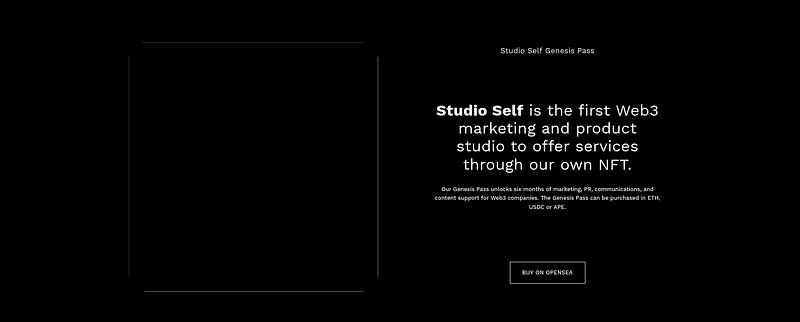
Studio Self wasn’t just talking about Web3, they were selling it on-chain.
“Studio Self is the first Web3 marketing and product studio to offer services through our own NFT. Our Genesis Pass unlocks six months of marketing, PR, communications, and content support for Web3 companies. The Genesis Pass can be purchased in ETH, USDC or APE.”
Think about that architecture for a moment. You couldn’t hire Studio Self with a simple contract and payment. You had to buy an NFT. On OpenSea. To get access to marketing services. For your Web3 company. Which you were probably also funding with NFT sales. It’s turtles all the way down, except the turtles are JPEGs.
Westenberg wasn’t merely running a Web3 agency, though. She was a leader in MODA, the blockchain music movement, and positioned herself as founder of the Web3 creative firm Studio Self. In April 2022, she appeared on the “Crypto Girls” podcast as “a writer, angel investor, creative director, and marketing lead at MODA DAO.”
Then there was The DAO Joan Index, a newsletter for crypto builders published on Paragraph, a Web3 publishing platform, with content stored on Arweave blockchain. Because of course it was. In December 2022, the newsletter opened with: “Welcome to The DAO Joan Index! I am thrilled to have you join our community of builders.”
The newsletter provided detailed analysis of NFT gaming integration. Q&As explaining how players could earn money from NFTs. One particularly revealing line, almost thrown away: “A cool term to describe P2E mechanisms is, of course, ‘Ponzi scheme.’” Was this always tongue-in-cheek? A wink to those who knew?
The True Believer
In January 2023, less than three years ago, which in internet time is nothing and in crypto time is three entire geological epochs, Westenberg published 50 predictions about Web3’s next decade. The tone wasn’t hedged or cautious. This was prophecy:
“The millennial demographic will be the most open demographic to replacing their savings, assets and retirement accounts with crypto and NFT assets. They have zero hope. Zero. Hence—they have nothing to lose.”
There’s something cynical in that formulation. The hopeless will gamble on magic beans because what else is there?
“The most important emerging asset class is not Crypto, it is NFTs. The blockchain powered, next generation of Non-Fungible Tokens (NFT’s) built on new standards and protocols will completely change the global financial paradigm.”
“As a result, the total market cap of crypto assets will exceed the combined global reserve balances of USD, YEN, EURO and our current global fiat currency system.”
These weren’t possibilities. Not maybes or perhapses. These were certainties, delivered with the confidence of someone who had seen the future and found it profitable.
She wrote extensively about the technical details too. NFT music, she argued, wasn’t about replacing streaming but “establishing networks of collectors who can trade and sell digital music pieces as either art or assets, which can become the core foundation of a creator’s career.”
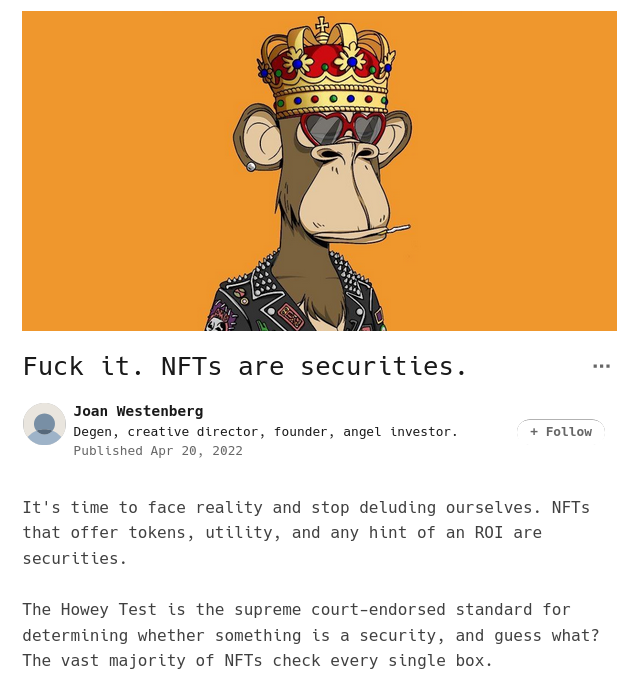
In April 2022, she published “Fuck it. NFTs are securities,” arguing that the vast majority of NFTs met every criterion of the Howey Test. But rather than sounding alarm bells,she framed this as positive, “Before you get too upset, let me explain why this is actually a good thing.”
The regulatory hammer was coming, in other words, and somehow that was bullish. She even warned others about grifters, writing a now-lost article titled “How to avoid NFT Consulting Grifters”.
The Loss
February 2023. The turn.
Another lost LinkedIn post opened like this, “How I minted a fucking historic NFT edition and lost 50 ETH plus a chunk of my life’s savings…”
She’d created the BTC Orb project, attempting to mint 999 editions as “the first Manifold-enabled Edition on the Ordinals Protocol, bridged from Eth.” Raised funds at 0.05 ETH per mint. The goal was conservative, the timeline careful, the execution professional.
“The bad news is that the first dev I hired has ghosted me and stolen most of the funds I raised for the project. The dev, Appx.eth, who came recommended to me from several sources… delivered on a bunch of the design, dev, and deployment work and successfully inscribed the provenance token before disappearing with funds for 50% of the dev work, and funds for gas on BTC.”
“I lost close to 50 ETH, the full amount I raised to cover the inscriptions.” At February 2023 prices, that’s roughly $80,000. At peak prices when she likely raised it? North of $150,000. This was financial ruin dressed in blockchain jargon.
The remarkable thing about the post is its honesty. The detail. The admission. “The dev… came recommended to me from several sources, and who was confirmed to have worked with the Chungos team.” She did her due diligence. She followed the rules of the space. She got rugged anyway.
Code is law in Web3 until someone steals your money, and then suddenly personal responsibility is the only law that matters.
The Pivot
By October 2024, Westenberg published “Idealists, Builders, and Extractors in a Dream Deferred.” The framing had undergone a complete phase shift.
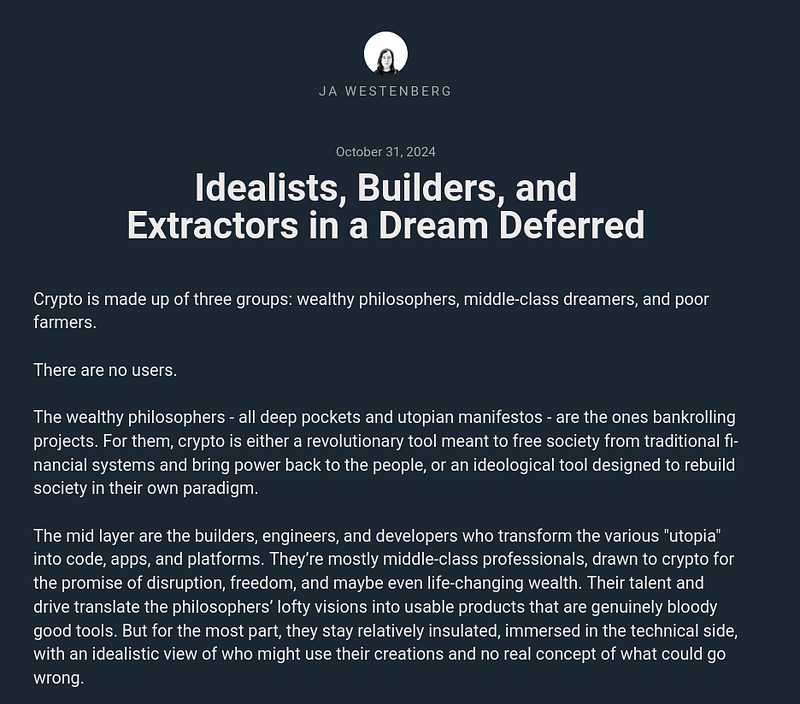
No longer a builder in the space. Now an outside analyst. A sociologist of the movement rather than a participant:
“Crypto is made up of three groups: wealthy philosophers, middle-class dreamers, and poor farmers. There are no users.”
She continued, “The mid layer are the builders, engineers, and developers who transform the various ‘utopia’ into code, apps, and platforms… Their talent and drive translate the philosophers’ lofty visions into usable products that are genuinely bloody good tools. But for the most part, they stay relatively insulated, immersed in the technical side, with an idealistic view of who might use their creations and no real concept of what could go wrong.”
Wait. Pause. Rewind.
Wasn’t she literally in that mid layer two years prior? Running a Web3 marketing studio? Leading MODA DAO? Publishing daily crypto newsletters? Selling services as NFTs?
The piece concludes: “Crypto’s dream of leveling the playing field is undermined by the very people who keep it alive. Until these groups can connect and understand each other—and understand what’s missing—crypto will stay trapped in this loop: funded by idealists, built by dreamers, and devoured by those who can’t afford to believe in any dream but their own survival.”
“Devoured by those who can’t afford to believe in any dream but their own survival.”
Who devoured her 50 ETH again? And more importantly—who was selling the dream to those who couldn’t afford to lose?
The Erasure
Here’s where the magic happens. The real craft. Let’s compare Studio Self’s positioning across time:
July 2022: “A marketing studio and product lab built for web3”
August 2025: “Creative work with consequences. We’re a creative consultancy, advertising shop, and branding lab founded by Joan Westenberg.”
The word “web3” has been completely excised. The Genesis Pass NFT? Never happened. The mission to help crypto companies communicate with humans? What crypto companies?
The new Studio Self lists clients: “BHP Ventures, Main Sequence Ventures, Q-CTRL, Flare, Goterra, Evrima, Josef, Willed, Hearsay, Xakia.”
Traditional venture capital. Traditional corporate clients. The kind of companies that have offices and email addresses and don’t require you to connect your MetaMask wallet.
Not a single crypto company mentioned.
Her current Medium bio says “I founded Signalvs, a media lab, startup, and agency, and The Index, an independent, reader-funded news site.”
No mention of MODA DAO. No mention of being a leader in the blockchain music movement. No mention of Studio Self ever being a Web3 firm. Her LinkedIn describes her as someone who founded “Signalvs, a communications consultancy” with expertise in “Philosophy, technology, and strategy.”
Studio Self, listed as active from 2019 to present, features generic language about “Advertising” and “Creative Agencies.” The Web3 focus? Scrubbed like a crime scene.
The DAO Joan Index newsletter? The only post was from December 2022.
The Artifacts
On Foundation.app, Westenberg’s NFT collection still exists, immutable as promised. The pieces have titles like “The Degen,” “The VC,” “The Influencer,” “The Allowlist,” “The Creator,” “The Alpha Group.”
One is listed at 1,000 ETH. Another at 100 ETH. A third at 10 ETH.
These read as satirical commentary on crypto culture. Biting. Self-aware. When were they minted? During the height of her Web3 involvement. Were they always ironic? Or has the framing shifted now that the market lies in ruins, the way a failed revolution gets recast as performance art?
The prices suggest something. Nobody lists an NFT at 1,000 ETH expecting it to sell. That’s not a price. That’s a statement. But what statement? “This is worthless”? “This is priceless”? “This is a joke on everyone who thought it was worth something”? Maybe all three at once.
The Pattern
In my own article “The Piss Average Problem,” I wrote about the NFT collapse and how evangelists pivoted:
“The NFT collapse provides us a template. The entire ecosystem of speculation, celebrity endorsement, FOMO-driven investment, and solutions seeking problems collapsed. Nike acquired RTFKT for $200 million only to wind down operations while facing a $5 million lawsuit. Meta positioned themselves around metaverse and NFTs only to quietly removed NFT integration from Instagram. DraftKings shut down Reignmakers and settled $10 million in lawsuits.”
I was thinking of the broader movement. But Westenberg exemplifies something more specific, more refined. She’s the professional communicator who rides the wave, builds the infrastructure, loses money herself, and then disappears the entire chapter with such completeness you start to question whether it ever happened at all.
This isn’t about whether crypto or Web3 was legitimate. Reasonable people disagreed, and many who were earnestly involved lost money and moved on with dignity. That’s not grift, that’s just being wrong, which is human and forgivable. What makes this pattern suspicious is the architecture of the erasure:
- The completeness—Not “I was involved in Web3 and learned hard lessons” but rather acting as if it never existed
- The lack of accounting—No post-mortem, no “here’s what I learned,” no reckoning with the evangelism
- The narrative repositioning—Writing about crypto as an outside analyst mere months after being deeply embedded
- The professional advantage—Using communication skills to memory-hole uncomfortable history while maintaining credibility It’s the difference between a failed business and a magic trick.
The Question
Is Joan Westenberg a grifter?
The word implies intentional deception for profit, which is a high bar. I don’t know her intentions. Can’t read minds, don’t claim to. Maybe she genuinely believed in Web3 with the fervour of the converted. Maybe the 50 ETH loss was a genuine wake-up call, the scales falling from her eyes in real-time. Maybe she just wants to move on with her life. But here’s what I do know, what can be documented and archived and proven:
In July 2021, Mediaweek interviewed Westenberg about Studio Self hitting six figures in six months. She said “My big business goal overall is that I want to run a successful, profitable company and show other people that that’s what trans people can do. There is no limit to what we can do.”
That’s admirable. Genuinely. Representation matters. Visibility matters. Breaking through barriers matters.
A year later, that successful company was selling its services exclusively as Web3 NFTs. Two years later, any mention of Web3 has been scrubbed so thoroughly you’d need forensic tools to find traces.
In that same Mediaweek interview, she talked about releasing clients from their contracts during COVID.
“I said ‘look, I know Covid is playing merry hell with your business and it’s more important for you to be able to pay your staff than pay your PR agency, so you don’t have to continue with this contract and you can come back to it another time’. People appreciated that.”
That’s ethical business practice. Compassionate. The kind of thing you want to see in a world that increasingly feels designed to extract value from everyone it touches.
But it makes the Genesis Pass NFT model—where clients had to buy tokens on OpenSea, pay gas fees, connect wallets, navigate blockchain infrastructure just to access marketing services—look opportunistic by contrast. The COVID pivot was about making things easier for struggling clients. The Web3 pivot feels like it was about making things harder for everyone while extracting more value from the transaction.
The shapeshifting isn’t wrong. People evolve. Markets shift. Businesses pivot or die. But when you’re a professional communicator who writes extensively about authenticity, trust, and “creative work with consequences,” the complete memory-holing of a major business focus feels like something else entirely.
It feels like consequences are for other people.
The Current Act
Westenberg’s recent writing has found success with productivity criticism and philosophical musings. “I Deleted My Second Brain: Why I Erased 10,000 Notes, 7 Years of Ideas, and Every Thought I Tried to Save” resonated with thousands of people exhausted by optimization culture.
She writes thoughtfully about Philosophy, technology, and meaning-making. Her pieces on “The Navalification of Everything” and being “Exhausted By My Own Cynicism” capture something real about our current moment.
The writing is good. Actually good. Sharp, clear, often landing hard truths about tech culture and digital life.
But what I can’t shake is when she writes about tech hype, about extraction, about the ways digital culture sells us solutions to problems it created, I keep thinking—where was this skepticism when you were selling Genesis Pass NFTs?
In “Idealists, Builders, and Extractors,” she writes “farmers mine these projects for short-term gains, reducing the dreams they encounter to rubble.”
But what about the marketers who sold the dream? What about the agencies that charged in ETH, that positioned themselves as Web3 natives, that told people this was the future of work and money and creative practice? What about the newsletters teaching people how to earn money from NFT gaming, published on blockchain platforms, archived immutably for anyone willing to look?
The farmers extracted value from the dreams. But someone had to plant those dreams first. Someone had to tend them, water them, convince people they were real and worth investing in.
The Lesson
I don’t think Joan Westenberg is a grifter. She’s more likely someone who got caught up in the excitement, genuinely believed, built a business around that belief, lost money when it collapsed, and then moved on the way anyone would.
What I do know is that the digital archive tells a story of someone who went all-in on a trend, profited from it (at least initially), lost when it collapsed, and then scrubbed the entire era from their public narrative without acknowledgement or accounting.
It’s certainly not the transparency and authenticity that gets preached in every piece about digital culture and tech ethics.
The broader lesson here isn’t really about Westenberg specifically. She’s just one example of many I’ve found of something much larger and more pervasive.
We live in an age where your entire professional history can be archived on the Wayback Machine, where your NFT collections remain on-chain forever, where your old newsletters still exist on decentralized platforms that can’t be taken down. The blockchain is immutable, we were told. Everything is recorded forever.
And yet.
Most people won’t look. Most people will accept the current narrative at face value because doing the archaeology is exhausting, because who has time, because what does it matter anyway?
Reinvention is always available to those articulate enough to pull it off. Digital memory is infinite but human attention is finite.
You can be all-in on something, lose everything, pivot completely, and most people will never know or care.
Coda
If you’re going to write about authenticity, you should probably acknowledge all your past selves. Even the ones that embarrass you. Especially the ones that embarrass you.
The shapeshifter survives by changing forms. But survival isn’t the same as integrity.
And in the end, we all leave traces. Digital exhaust. Archived pages. On-chain records. The ghosts of our past selves, waiting in the Wayback Machine, ready to testify about who we were when we thought no one was watching.
Comments
To comment, please sign in with your website:
How it works: Your website needs to support IndieAuth. GitHub profiles work out of the box. You can also use IndieAuth.com to authenticate via GitLab, Codeberg, email, or PGP. Setup instructions.
Signed in as:
No comments yet. Be the first to share your thoughts!