Community Will Save Your Life

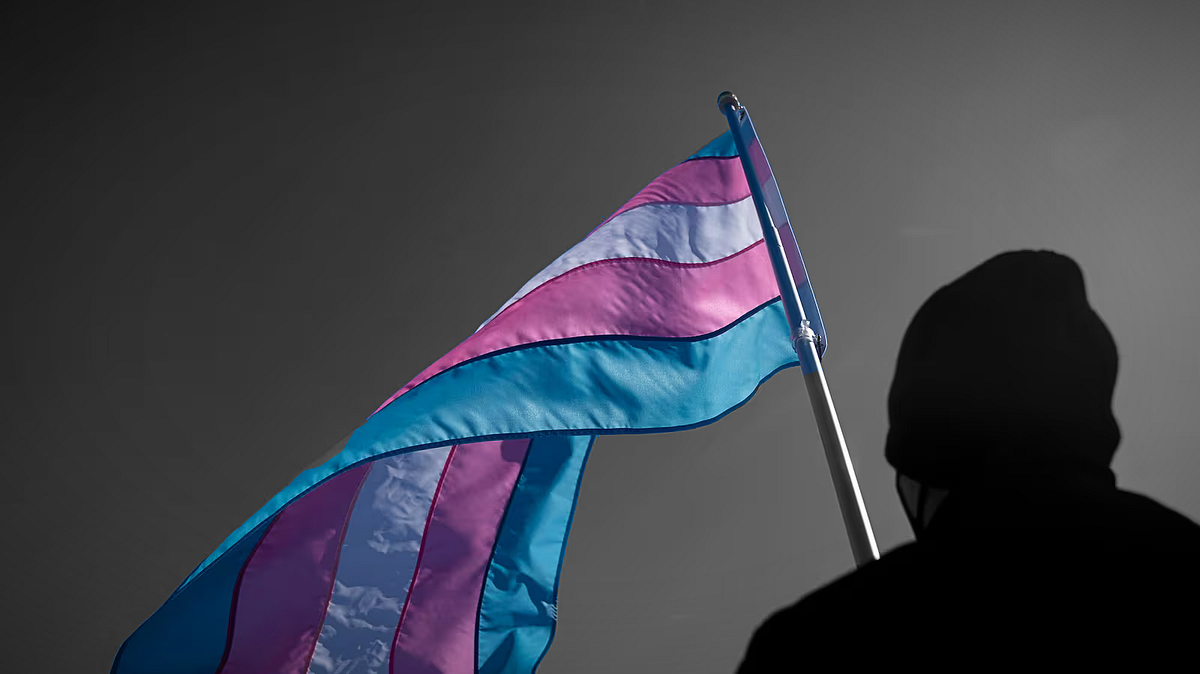
In my quiet wooden study, I’ve been staring at my chipped black-painted nails, trying to process the latest news. The cloudy blue-green lava lamp I resurrected from a thrift store two years ago bubbles beside me. Hermanos, a vivid ceramic red skull painted with beautiful flowery decals, sits on the top shelf of my desk. Watching. The trans flag in my pencil holder tilts.
NOTWITHSTANDING.
Today is Trans Day of Remembrance. November 20th. A day we honour the trans lives lost to violence. Every year, we read the names. Every year, the list grows longer.
In 1999, we began this memorial after Rita Hester, a 34-year-old Black trans woman, was murdered in Boston. Twenty-six years later, we’re still reading names. Still fighting the same battles. Still burying our dead.
In Canada, 59% of transgender and gender-diverse people experience violent victimization, compared to 37% of cisgender people. These are our siblings, our friends, our community members.
I believe the strongest weapon we have against this violence, both physical and legislative, is community. Not the abstract idea of community. Real, physical, face-to-face, messy, embodied community. The kind that shows up and stays.
Two days ago, Alberta invoked the notwithstanding clause to shield three laws affecting transgender youth and adults from legal challenges. The clause blocks Charter challenges for five years. Suspends the Alberta Bill of Rights and Human Rights Act in perpetuity. The timing wasn’t accidental. It was cruel. Calculated. A message that lives, rights, and people’s very existence can be overridden with political expediency.
I sip day-old instant coffee from my Tim Horton’s mug. The taste of no-name diet soda lingers because every other brand is on the BDS list. Homemade chocolate chip cookies cool on a plate someone left for me. The blue plastic broom leans against the wall. Incense reeds with fir and cedar essential oils burn low. There is always an ongoing process of grief.
Student Quin Bergman said their sibling was driven to suicide by an onslaught of hate toward transgender people. “It’s stuff like what the government is doing that makes people lose hope,” they told reporters outside the legislature.
This is the second time in less than a month that Premier Danielle Smith’s government has used the clause. The first was to end a teachers’ strike. Trans advocate Marni Panas warned “Yesterday it was teachers, today it’s transgender people. Who’s next?”
I’ll ask the question I’ve been asking for awhile now, how do we reckon with this? For me, I refuse to let hope die here. We need to come together. Now.
But I also refuse to pretend building community is easy or clean or free from friction.
Community doesn’t materialize from solidarity alone. Infrastructure is required. Physical spaces, organizational structures, consistent effort. When governments actively work to dismantle the conditions that allow marginalized people to survive, we can’t merely express outrage online. We need tangible places to gather, to organize, to simply exist together.
This is what I was thinking about when I started something small, imperfect, and entirely my own. As a Queer Métis man, I’ve seen how quickly institutional spaces disappear when they’re needed most. I’m telling my own story of community.
I think one of the most effective ways to answer the question “what’s meaningful?” is to create something entirely of your own. A completely independent endeavour. I believe we all need our own project. There’s proper channeling, focus, skill learned and experience gained. But that’s all irrelevant to the most important thing, which is that nothing is independent anymore.
Everyone chases the validation of the label, the publication, the corporate buy-in. All of this leads to the eventual sunsetting of the original project.
Phil Gyford started cataloging this phenomenon in 2013 with a Tumblr called “Our Incredible Journey.” Startup after startup gets acquired by big tech and then announces they’re “thrilled” about their “incredible journey,” then shuts down their service.
Gyford calls it morally wrong that startups persuade thousands of people to devote their time and energy to using a service that is summarily erased once the owners have been paid off.
It’s the same pattern threatening us now. Institutions we thought would protect us revealing they never belonged to us at all. Rights we assumed were permanent, suddenly provisional. Communities we built on platforms that vanished overnight. (I’ll get back to this point later)
This is why I wanted to create something from scratch entirely independently. Something that couldn’t be acquired, shut down, or legislated away with a single clause. I founded Write Club at Mount Royal University in September 2022. Mostly because no creative writing club existed on campus. A simple problem, simple solution. Except being president of a writing club barely has anything to do with writing.
It is administrative affairs. Dealing with the students’ association trying to wrangle the right insurance paperwork for an offsite event. Ensuring our socials were consistent and up-to-date. Hosting and moderating writing meetings. Running a Discord server. Fundraising and organizing author readings, poetry slams, bookstore collaborations, and publishing indie anthologies.
…But all of this is a microcosm for politics in general, isn’t it? A fantastic campaigner is usually never a good politician. Likewise, being knowledgeable about policy rarely means you have the skills to ensure they’re enacted properly.
The Price of Community Is Annoyance
There are so many people in the world. So much overtakes our energy and time that we develop a fallacy. thinking that we aren’t obligated to any particular person. We think we can gossip, be dismissive, form cliques. Pick and choose. Ostracize. Isolate.
This is understandable, but it is also a dangerous fallacy. I do not believe we have the luxury of picking and choosing anymore.
The government is betting we’ll fracture. That we’ll be too divided, too exhausted, too busy fighting each other to mount effective resistance. That our allies will decide some fights aren’t worth the discomfort of staying.
So let’s talk about discomfort. Now, I want to be clear this isn’t about friendship, that’s an entirely different topic and discussion. A lot of people conflate friendship with community. They are not the same thing. You don’t need to be friends with everyone in your community. You just need mutual respect and good faith.
When you have a community with radical acceptance of who’s allowed in, people are going to clash. Some people are going to be considered difficult or weird. How do we deal with that?
I always simply answered by treating everyone the same, regardless of how other people felt. This wasn’t wrong, but it wasn’t proactive enough.
I think of the people who came to a writing meeting or two, then left never to be seen again. In business, this is called churn. Conversion drop-off. A leaky funnel. But unlike a capital-centric business, I wasn’t losing money. I was losing potential connection. The world was maybe losing potential writing and art.
You’ll be told that you can’t please everyone. That you need to focus on a specific demographic. But this goes back to my point on annoyance—all we have is each other.
We need to be able to genuinely engage with one another in good faith.
The Circular Firing Squad Problem
There is such hypervigilance in a lot of leftist spaces right now. People who share nearly the same values find themselves in a schism because of a disagreement on a particular point.
The left has a reputation for eating itself. The Monty Python “People’s Front of Judea” sketch from Life of Brian skewered this in the 1970s—four members bickering internally while bemoaning Roman rule.
War drone enthusiast Barack Obama coined the term “circular firing squad” in 2019, warning progressives against creating “a certain kind of rigidity” where “you start shooting at your allies because one of them is straying from purity on the issues.”
The phenomenon is real. Historically documented. The abolitionist movement fractured over tactics despite sharing the same core goal. Feminist “sex wars” pitted anti-porn feminists against sex-positive feminists; women of colour felt sidelined and formed separate movements. LGBTQ+ rights advocates distanced themselves from drag queens, trans people, and sex workers, the very groups who led the Stonewall uprising. Mao’s Cultural Revolution became a violent purity campaign where Red Guards attacked teachers, artists, and loyal Communist Party members for “counter-revolutionary” behaviour. Revolutionary idealism became self-devouring.
Dutch historian Rutger Bregman puts it simply.
“If people agree with you for 80 percent of the time, then they’re not your enemy, they’re your ally.”
But the term “purity politics” also gets weaponized by centrists and establishment figures to dismiss principled progressive positions. Citations Needed podcast calls it a “conversation stopper” that uses pop psychology to avoid real debate about balancing ideals and pragmatism.
The online left can turn into an endless hamster wheel of rage and lefty purity tournaments while real organizers are on the ground striking and unionizing. Christian Smalls, the fired Amazon worker who spent months stationed outside the Staten Island warehouse leading unionizing efforts, sees the online infighting as an impediment to real change. “It’s unfortunate and counterproductive to any cause,” Smalls said.
“My only wish is that the left breaks this cycle of infighting and realize when we come together we can accomplish great things.”
While leftists argue online about who’s problematic, Danielle Smith invokes the notwithstanding clause. While we debate the correct terminology and cancel each other over imperfect allyship, teachers lose their right to strike and trans youth lose access to healthcare. The right doesn’t care about our purity tests. People lose rights while we’re eating our own.
A current worker helping to lead unionizing efforts at Starbucks in Buffalo said it plainly. Purity isn’t power.
The Paradox of Alternative Spaces
Here’s a tricky paradox that comes inherent to any of these existential questions, how do you possibly enact any sort of cohesive consistency with a fluid and diverse group of people?
You cannot—and definitely should not—control people or their values. You can try explaining your line of thinking, but people are free to reject it.
I could try to make a new platform or community meant to be human-only, grassroots, leftist, principled. The problem? Look at what happened to every alternative to mainstream social media.
There are two types of “alt-tech” platforms: “co-opted platforms” like DLive and Telegram with minimal moderation that attracted extremists, and “bespoke platforms” like BitChute, Gab, and Parler created by people with far-right leanings.
The tragedy isn’t just that these platforms exist. It’s that when deplatformed users migrate to alternative platforms, “these sites are given a boost through media attention and increases in user counts,” making it harder to police extremist threats. The very act of creating alternatives can make the problem worse.
The “alt-right pipeline” is well-documented. YouTube recommendations lead users from less radical to more extremist content. Many social media-radicalized mass shooters credited internet communities for the formation of their beliefs.
This matters for trans survival. When marginalized communities can’t build alternative spaces without them becoming extremist cesspools, where do we go when mainstream platforms ban us, when governments legislate us out of existence, when public spaces become hostile? If every alternative gets poisoned by fascists, we’re trapped in systems that are actively trying to erase us.
So what do we do? Surrender the possibility of building independent spaces? No.
But we have to be honest about how difficult it is.
The Boring, Beautiful Work of Showing Up
Community organizing is “base-building.” It involves developing grassroots leadership to advocate for policy solutions and changes to systems that produce inequities. Success requires combining long-term vision with practical tactics: broad-based coalition building, effective messaging, direct action, and inclusivity.
The best organizers “host parties, go to comedy shows and arts events, and emphasize wellness and self-care to build relationships and manage activism stress.”
Historical grassroots movements “doubled as social networks—civil rights activists sang together in churches, early labor organizers held picnics and dances.” Celebrating milestones as a group builds camaraderie. “A strong sense of community can sustain volunteers even through tough campaigns.”
Isolated people are easier to legislate against. They know atomized communities can’t mount sustained resistance.
But movements that focus solely on short-term mobilization without strong organizational foundation struggle to achieve lasting impact. Organizations that don’t foster inclusive decision-making “risk alienating members and weakening internal cohesion.”
You have to let everything fall and fail except your values. Never bend the knee or compromise when it comes to what you think is important to the ethos and culture and norms you’ve created.
For the club I ran, that meant everyone’s voice matters. We centred marginalized voices without tokenizing them. We don’t tolerate bigotry but we allow for learning and growth. We made space for messiness and imperfection. These were operational, rather than aspirational.
The Commodification of Resistance
Anything that is resistance against the status quo eventually gets consumed into it, reified and commodified.
Reification is a concept developed by Georg Lukács in 1923, building on Marx’s “commodity fetishism.” It means “making into a thing”—the transformation of human properties, relations, processes, actions into things. Verbs into nouns.
Lukács defined it as when “a relation between people takes on the character of a thing and thus acquires a ‘phantom objectivity,’ an autonomy that seems so strictly rational and all-embracing as to conceal every trace of its fundamental nature: the relation between people.”
In simpler terms, we turn living, breathing human connections into objects that can be bought and sold. This is what happens to movements. To art. To community spaces.
This is how resistance dies. Not through direct oppression alone, but through the transformation of our movements into products, our solidarity into brand identity, our survival networks into monetizable platforms. When Write Club becomes a franchise, it‘s shut down by market forces. When trans resistance becomes aesthetic, it’s defanged and sold back to us as rainbow capitalism. The government doesn’t need to ban what venture capital will eventually destroy.
I refuse to let that happen.
Write Club isn’t for sale. When I graduated and stepped down as president, I handed it to people who understood the mission. Who were there for the right reasons. Who would protect what we built.
The Only Path Forward Is the Uncomfortable One
Online, everyone is an avatar. A profile picture. A collection of takes. You can block, mute, unfollow. You can curate your experience to eliminate friction.
In a physical community space, you can’t do that. You have to sit across the table from someone whose specific stances on particular subjects you find frustrating. You have to share space with someone whose personality grates on you. This is the work.
Not the glamorous work of protests and direct action. The work of staying.
I’m asking you to cultivate comradeship with people that aren’t like you. To understand and foster community even when it’s annoying. Especially when it’s annoying.
The Alberta’s government fears our infrastructure. Not our politics, but our presence. Sustained, embodied, messy human connection that can’t be legislated away with a single clause.
Constitutional experts in Alberta warned about a “slippery slope” when rights are violated for one group. “If we allow this to continue, nobody’s rights are safe,” Marni Panas said.
The same logic applies to community as a whole. If we only welcome people who are exactly like us, who never frustrate us, who always agree with us—we don’t have community. We have an echo chamber that will collapse the moment real pressure is applied.
Real community is messy. It’s uncomfortable. It requires negotiating difference, managing conflict, extending grace, setting boundaries, apologizing, forgiving, trying again.
What I’m Asking You to Do
If I have any sort of actionable advice to end this with, it’s that I ask you to try to live in discomfort. Not just with your work, but with people as well.
This is not about the paradox of intolerance. I’m not saying tolerate bigotry. I’m not saying welcome fascists to the table and debate them in the marketplace of ideas.
I’m talking about the things that give you the “ick.” The personal dislikes. The annoyances. The people who agree with you 90% of the time but that 10% feels like nails on a chalkboard.
Try to understand them anyway. Try to build with them anyway.
Create something for the people around you, no matter who they might be. Invest in local. Work with what you have—including the people who are actually there, not the idealized community you wish existed.
Keep it sacred. Do not profane it by trying to offload it or sell it.
We must continue showing up for each other when rights are being stripped away. When teachers are being legislated back to work. When trans youth are losing access to healthcare. When the world feels like it’s burning and the only thing we have is each other.
We are always so much more similar than we are different.
I look at Hermanos on my shelf, at the trans flag in my pencil holder, at the remnants of cookies someone made for me. The fir and cedar incense has burned down to nothing. My coffee is cold. There is so much more work to do.
Resources and Actions: What We Can Do Now
The Alberta government is betting that we’ll be too overwhelmed to organize. They’re wrong. Here are concrete ways to support trans people in Alberta and resist these harmful policies.
IMMEDIATE CRISIS SUPPORT
If you or someone you know needs help right now:
- 9–8–8 Suicide Crisis Helpline—Call or text 24/7, available in English and French
- Trans Lifeline—1–877–330–6366—Peer support hotline run by and for trans people (Canada & US)
- Kids Help Phone—1–800–668–6868 or text CONNECT to 686868—For youth ages 5–20
- Alberta Mental Health Help Line—1–877–303–2642 (24/7)
- Brite Line (Edmonton)—Edmonton’s first mental health and wellness helpline dedicated to supporting 2SLGBTQIA+ community
- Distress Centre Calgary—403–266–4357
- Distress Line Edmonton—780–482–4357
TRANS SUPPORT ORGANIZATIONS IN ALBERTA
Skipping Stone Foundation (Calgary-based, serves all Alberta)
- Provides low-barrier access to comprehensive care for trans and gender diverse youth, adults, and families across Alberta
- Offers peer support, mental health services, medical navigation, and Trans ID Clinics
- Donate or Volunteer—They urgently need financial support to continue operations
- Donate via CanadaHelps or GoFundMe Trans Equality Society of Alberta (TESA)
- Advocacy organization that has been a voice and witness for trans Albertans since 2009 Tesaonline
- Offers binder exchange program and system navigation support Queer & Trans Health Collective (Edmonton)
- Grassroots health organization run by and for queer and trans community
- Health education, support, capacity building, community-based research Calgary Outlink
- Community-based charity providing support, education, outreach, and referrals
- Runs “You Matter” peer support line for 2SLGBTQ+ community Trans Parent Alberta 101
- Comprehensive resource compilation for parents, families, and allies
LEGAL SUPPORT AND ADVOCACY
- Leading the constitutional challenge against Alberta’s anti-trans legislation alongside Skipping Stone and five gender diverse youth
- Continuing legal fight despite notwithstanding clause
- Donate to support ongoing litigation
- Follow for updates on legal challenges Canadian Civil Liberties Association
- Monitoring use of notwithstanding clause
- Provides resources on Charter rights McCarthy Tétrault LLP
- Law firm providing pro bono representation for the constitutional challenge
TAKE ACTION: CONCRETE STEPS
1. Sign Petitions and Add Your Voice
- Trans Action Alberta petition opposing use of notwithstanding clause
- Contact your MLA—Even if they support the legislation, register your opposition
- Submit feedback to Alberta Health and Education ministries 2. Financial Support
- Donate to Skipping Stone—They’re operating on community donations after the province refused funding
- Donate to Egale Canada—Support ongoing legal challenges
- Contribute to Trans Lifeline—Peer crisis support by trans people, for trans people
- Set up recurring monthly donations to Alberta trans organizations 3. Community Organizing
- Join or start a local solidarity group
- Attend rallies and demonstrations (follow Skipping Stone, TESA, Pride Centre of Edmonton for event announcements)
- Organize fundraisers for trans-led organizations
- Create mutual aid networks—Direct financial support, rides to appointments, housing assistance 4. Education and Advocacy
- Share accurate information about trans healthcare from medical professionals
- Challenge misinformation in your community
- Amplify voices of trans people, medical professionals, and advocacy organizations opposing these laws
- Write letters to the editor of local newspapers
- Contact the Canadian Medical Association, Alberta Medical Association, and Alberta Teachers’ Association to express support for their opposition 5. Professional and Business Support
- If you’re a healthcare provider, join the Trans Wellness Initiative
- Businesses can join Skipping Stone’s Trans Affirming Network
- Host fundraisers (like Calgary’s tattoo shops donating 100% of flash proceeds)
- Offer pro bono or sliding scale services to trans community members 6. For Educators and School Staff
- Familiarize yourself with your obligations under the new legislation
- Find ways to support trans students within legal constraints
- Connect families with resources outside school systems
- Join Alberta Teachers’ Association advocacy efforts 7. Build Long-Term Infrastructure
- Start or join a local GSA/QSA
- Organize regular community gatherings (coffee meetups, craft nights, support circles)
- Create skill-sharing networks
- Document and share organizing strategies
FOR TRANS PEOPLE: KNOW YOUR OPTIONS
Healthcare Navigation
- Despite the legislation, trans adults can still access gender-affirming care
- Contact Skipping Stone or Pride Centre of Edmonton for help navigating the system
- Trans Wellness Initiative has resources for both patients and providers
- Consider connecting with providers in other provinces if necessary Legal Identity Documents
- Skipping Stone offers Trans ID Clinics in Calgary to help with name changes and gender marker amendments
- Process federal documents (passport, SIN) which aren’t affected by provincial laws Mental Health Support
- Access counselling through Pride Centre of Edmonton or QTHC
- Many organizations offer sliding scale or free services
- Telehealth options available through some providers Egale and other organizations have stated that the fight isn’t over despite the notwithstanding clause. The clause must be renewed every five years, and sustained public pressure can create political consequences.
This is about all of us. This is about a government willing to override fundamental rights when politically convenient. This sets a dangerous precedent for all Albertans’ rights
The most important thing you can do is show up. Stay. Build infrastructure that can’t be legislated away. Create community existing in physical space, not only online. We need each other now more than ever.
Comments
To comment, please sign in with your website:
How it works: Your website needs to support IndieAuth. GitHub profiles work out of the box. You can also use IndieAuth.com to authenticate via GitLab, Codeberg, email, or PGP. Setup instructions.
Signed in as:
No comments yet. Be the first to share your thoughts!