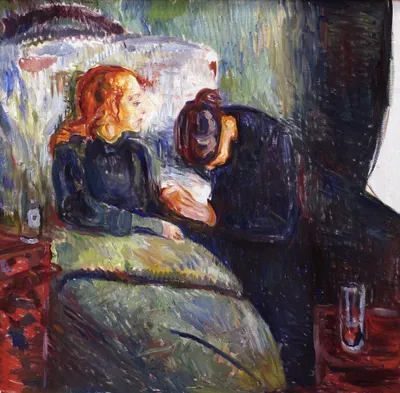
'The Sick Child' by Edvard Munch, 1907 | Wikimedia Commons
issue #163 of brennan.day
CLEAN AIR: Long COVID Is a Catastrophic Public Policy Failure
brennan.day — issue #163
Publisher: Brennan Kenneth Brown
Place of publication: Calgary, Alberta, Canada
Available at: https://brennan.day
Contact: mail@brennanbrown.ca
A few months ago, I wrote an article about how the COVID-19 pandemic never ended and the small percentage of people in the world who still treat the issue with the severity and gravity it deserves.
It is one of my most popular articles I've written, resonating and validating to those who are affected by Long COVID or similar, or simply those who understand the science and care for others. I haven't written about it since, despite this. I typically only write on a topic when I have something to say, and that's usually only once.
But there were some really important things I left out of my original article, to the point where I think it changes the entire framing of the conversation.
Clean Air
One of the main criticisms I received was that I was focused on what the individual ought to do in response to the ongoing pandemic: vaccinate and mask up.
In reality, this is not an issue that can be solved on the individual level — any personal action somebody takes is harm reduction and mitigation. It was frankly naïve and ignorant of me to proclaim these as the most effective countermeasures we have.
What we need is simple. Clean indoor air.
We spend roughly 90% of our time indoors. Offices, classrooms, grocery stores, clinics, libraries, the places where we collectively exist as a society. The air inside those buildings is not neutral. Air is a shared medium to be managed, or that isn't managed. Right now it is not.
Portable air cleaners with True HEPA filters capture 99.97% of airborne particles as small as 0.3 microns, which includes SARS-CoV-2. They're effective at reducing transmission in indoor spaces.
But for larger buildings, the real intervention is at the infrastructure level, HVAC filters rated MERV 13 or higher, which are at least 85% efficient at capturing virus-sized particles in the 1-to-3 micrometer range. The CDC and ASHRAE (the American Society of Heating, Refrigerating and Air-Conditioning Engineers) now both recommend MERV 13 as the minimum standard for occupied buildings, alongside a target of at least five air changes per hour in occupied spaces. "It's a monumental shift," Joseph Allen, director of the Harvard Healthy Buildings Program, told CNN when this guidance was released in 2023, saying that "we haven't had health-based ventilation standards" before.
To nobody's surprise, we've had the science for years. We have been building offices and schools and hospitals and courthouses with standards predating this. We are slowly, slowly updating those standards, and even more slowly beginning implementation.
Washington state revised building code in January 2023 to require MERV 13 filters in most occupancies, effective July 2023. California requires MERV 13 in schools and targets five air changes per hour. In 2022, the Biden administration launched the Clean Air in Buildings Challenge, calling on building owners across the country to assess and upgrade their indoor air. In July 2024, Representatives Paul Tonko (D-NY) and Brian Fitzpatrick (R-PA) introduced bipartisan legislation directing the EPA to set voluntary guidelines for indoor air quality nationwide, assess air quality in schools, and provide guidance and assistance.
That bill has not moved forward.
The Grassroots
During the early months of the pandemic, environmental engineer Richard Corsi proposed a DIY air cleaner design in WIRED magazine. Jim Rosenthal, CEO of a Texas air filter company, then built it. Four MERV 13 furnace filters duct-taped into a box, a household fan on top, assembled in fifteen minutes, costing between $50-$150 in materials. A 2022 study found the Corsi-Rosenthal Box achieves a clean air delivery rate of 600 to 850 cubic feet per minute at just 10% the cost of commercial air cleaners. Testing at UC Davis showed it can outperform HEPA air purifiers costing hundreds or thousands of dollars. One University of Colorado researcher measured a 92% reduction in fine particulate matter. 3M tested it and concluded it "performs exceptionally well."
I think of the homeless shelters and daycares and classrooms across countries where the Corsi-Rosenthal Box is desperately needed and possible.
To Show Up and Represent
This, then, becomes a public policy issue. We are tilting at windmills when we attempt to implore billions of people to change their individual behaviour, which has demonstrably failed in this sixth year of the pandemic. We instead need to be turning our attention to the politics of where we live. Local and state and federal. School boards. City councils. Provincial health authorities.
This is certainly no small task. A large number of those most affected by Long COVID have been disabled to the point where the political landscape itself is inaccessible and unaccommodating. There is a cruelty particular to systems requiring us to be well enough to fight for care for being sick.
It is up to us who are able-bodied and have the capacity to participate to get involved first-hand. I don't only mean showing up to a town hall meeting, though that is a start.
The Air of First Responders
In June 2019, Jon Stewart walked into a hearing room before the House Judiciary Subcommittee on Civil Rights and Civil Liberties. Behind him sat a room full of first responders—firefighters, police officers, paramedics—many visibly ill. Before him sat a subcommittee that was more than half empty. Only five members showed up to hear them.
Stewart broke down. He shouted. "Sick and dying, they brought themselves down here to speak to no one. Shameful." It was "an embarrassment to the country and a stain on this institution." The people behind him had run toward the burning towers on September 11, 2001. They had breathed the air of Ground Zero—thick with concrete dust, asbestos, benzene, PCBs, pulverized glass. More than 11,000 types of cancer have been reported among 9/11 survivors and responders, from glioblastoma to lung cancers that took two decades to develop. Cancers from the air.
Stewart had spent nearly a decade fighting for the James Zadroga 9/11 Health and Compensation Act, which passed in 2010 but required constant advocacy to remain funded and reauthorized. He devoted episodes of The Daily Show to it in 2010. He returned to the show in 2015, months after handing it to Trevor Noah, just to push for reauthorization again.
The next day, the Committee passed the legislation unanimously. It required a celebrity comedian to stand in front of a near-empty Congress, weeping, shaming them into doing what was right. And it required him to do it twice.
Those people behind Jon Stewart had been made sick by toxic air that was allowed to exist because it was politically inconvenient to address. The people behind us—the ones who cannot come to a hearing, cannot write a letter, cannot organize a phone bank because they cannot get out of bed—were made sick by toxic air that we collectively decided was not our responsibility to address.
The virus is airborne, and the harm is airborne. The solution is the air itself. We have a Zadroga Act to write. Have we begun?
The Bureaucratic Wall
This situation exemplifies why I'm a reformist instead of an abolitionist. We need modalities of government and social welfare programs to ensure the disabled have the support and services they need to survive and live. For a lot of people, the institution and government are their only options for getting support, despite how often this is an impossible bureaucratic nightmare.
The Social Security Administration's disability approval rate fell to 36% in fiscal year 2025, down from 38.7% the year prior. As of July 2025, roughly 940,000 people were waiting for an initial determination on their claims. A backlog higher than at any point during the Great Recession or the pandemic itself. The SSA experienced 20% reduced productivity during and after the pandemic due to extreme staff turnover and years of chronic underfunding. The number of applications has simultaneously dropped 7% in FY 2025, not because fewer people need help, but because people have stopped believing they'll receive it.
Long COVID does not have a specific diagnostic listing in the SSA's impairment criteria. Claimants must demonstrate, through extensive medical documentation, that their constellation of fluctuating and often invisible symptoms rises to the level of disability. This is extraordinarily difficult when medicine itself has spent five years dismissing those symptoms as psychological. Private insurers are no better, frequently denying Long COVID claims by arguing that a mild initial infection cannot produce serious ongoing impairment. This argument has no medical basis but is still a legally costly one to fight.
And the people fighting these denials are doing so while experiencing profound fatigue, brain fog, dysautonomia—all are the conditions making the sustained, detail-oriented bureaucratic effort impossible to maintain.
We need community and those who are able-bodied to provide aid and support to those who need it. Which is all of us. We all need one another, and all we have is each other. Many of us do not have the privilege of mindful, compassionate neighbours who will take care of us when we are ill. Likewise, many of us do not take up the mantle of helping our neighbours when they are ill.
The Hardest Truth
I would continue to be naïve if I wrote that I see a good ending and solution in sight to this existential health issue. We are compromised. Immuno-compromised, yes, but also morally. The most important issues we face are often the least popular or palatable. Trans people deserve rights and liberation and to live. Indigenous Peoples around the world deserve their land back—not the catchy performative #landback, but the actual functional dissolution of imperial colonial government. Animals deserve to live and not be slaughtered for our selfish consumption. And COVID-19 requires us to continue to mask, vaccinate, and be vocal and involved in politics in order to get clean air in public places and support social services.
None of this is a trend or just discourse. These are lives that have been collectively decided to be acceptable losses.
What You Can Actually Do
This is the section I find hardest to write, because I do not want to write another list for already-exhausted people. But uselessness dressed up as nuance helps no one.
On the political level: The most direct action you can take is to show up at the local level, where most indoor air quality standards are actually set and enforced. Building codes, school ventilation standards, and public health policies for nursing homes and transit hubs are primarily set and enforced by local and state governments. Most states have significant variation in indoor air quality standards, and local building inspectors and elected officials are the people who implement them. This means attending city council meetings and school board meetings and raising ventilation standards as a concrete agenda item. It means calling your school board trustee and asking what MERV rating their HVAC filters currently run, and whether they are planning to upgrade to MERV 13.
It also means considering whether you, personally, might run for one of these positions. I know how that sounds. But school boards in particular are sites of profound policy influence, including over the indoor environments where children spend most of their waking hours. You do not need to be a politician. You need to be someone who understands that the air in those buildings is a public health issue and is willing to say so, repeatedly, in rooms where decisions get made.
Beyond office, you can join or help build coalitions. Long COVID Justice maintains a searchable international map of advocacy groups, a Worldwide Mask Bloc Directory, and a directory of clean air organizations that lend out air filters for events. The Long COVID Alliance brings together science and patient advocacy organizations pushing for research funding and legislative change. These groups run phone banks, organize public testimony, and coordinate pressure campaigns on specific bills. They need volunteers who have energy to show up.
The Sick Times notes that state and local advocacy has sometimes produced faster and more durable results than federal lobbying, and that even when advocates lose legislative battles, as Triangle Mask Bloc did when North Carolina's mask ban passed in 2024, the organizing can win meaningful concessions, such as ensuring the final bill included a medical exemption.
On the community level: If you know someone who is ill or disabled (and you do, whether you realize it yet or not) the most important thing you can do is not profound. It is mundane. Grocery runs. Driving them to appointments. Sitting with them so they don't spend another day entirely alone. Checking in on them in ways that don't require them to perform wellness for your comfort.
Build a Corsi-Rosenthal Box and bring it to people who need it. It takes fifteen minutes and costs between $50 and $150 in hardware store parts. You can set one up in your own home. You can bring one to a gathering—a dinner, a meeting, a birthday party—so that people who are immunocompromised can participate in social life without choosing between community and their health. Make your space accessible to the people most often left out.
Mask up. It is still the most immediate individual step available while the infrastructure changes catch up.
Spinning Plates
There can only be so many spinning plates. I know this. I live in it too. There are genocides ongoing. There is a political apparatus in the United States actively dismantling the concept of democratic governance. There are environmental catastrophes accelerating faster than our language for them. There are trans children being legislated out of safety and medical care. The plates spin and spin, and some fall and shatter, and you must grieve while you keep spinning the ones still in the air.
The COVID-19 pandemic registers as a personal problem. As a series of sad individual stories. As the background hum of a world that has decided to forget something it never fully reckoned with.
I look over to the people on the other side of the reality schism. Those who still know the pandemic is real, who are navigating a disability system designed to deny them, who are too exhausted to advocate for themselves.
We owe them clean air. We owe them support. We owe them the indignity of actually showing up.


Comments
To comment, please sign in with your website:
How it works: Enter your website URL. IndieLogin signs you in through your site's IndieAuth server if it has one (e.g. indieauth.com), or checks your rel="me" links on GitHub, GitLab, Codeberg, and email. Setup instructions.
Signed in as:
No comments yet. Be the first to share your thoughts!