So I leave you with a smile, kiss you on the cheek, And you will call it treason
BoJack and the Temptation of Suicide

And I have tremendously fucked up with BoJack. I have realized I wasn’t worth salvation like BoJack—and yet received it anyways, like BoJack. Feeling as though I should have killed myself to make the world a better place but didn’t, like Bojack. Because of this, it’s difficult to talk about the character or the larger show without feeling parallax.
i. the pit
One of my first memories is the pit. My parents were fighting. About what, I cannot recall. Something mundane weaponized into something existential, I’m sure. But there was this sensation in the bottom of my stomach. A dark dropping. A hollowing. Like someone had reached inside my ribcage and scooped out everything vital, leaving only the walls. I didn’t have a name for it yet. But I learned to recognize it. The way you learn to recognize the smell of rain before the storm arrives.
The pit came whenever I missed a homework assignment or got in trouble. It arrived before the teacher’s disappointment, before the phone call home, announcing itself like a visitor I’d been expecting. The pit came when I had exams or was talking to someone I had a crush on. The same excavation, that same sense of my insides turning liquid and draining out through some invisible hole. The pit came when I got into arguments or overworked myself. When I woke up three hours before my alarm. When I heard my own voice in a recording. When someone said “we need to talk.”
The pit became a constant companion. More reliable than friends. More predictable than joy. And here’s the thing about living with the pit: eventually, you stop trying to climb out of it. Eventually, you start furnishing it. Arranging your life around its dimensions. Learning to function while that hollowing sensation pulses in your gut like a second heartbeat.
ii. mental health?
I must admit to you, since nobody else will, that the term “mental health” is a complete misnomer. We do not, as a species so far, understand how our mind works. It is multitudes more complex than our most advanced machinery—so how are we supposed to know when it’s healthy? We don’t. We make educated guesses. When we’re up for it, we try our best. When we’re not, it slowly dies with us.
So, what is mental health? Our ability to keep mere sanity? Small but consistent joy? 1 in 4 people will face a mental health problem every year. These are massive numbers for something we can’t properly define, measure, or cure.
BoJack Horseman matters because of this. There’s no answers, but instead, it shows the day after the ‘happily ever after’ and the day after that. Depicting depression as someone using drugs and acting out, as someone who seems from afar to be the opposite of depressed. Someone whose narcissism combines with depression to create a deadly cocktail of believing you’re uniquely sad in a world of happiness.
Studies have found that while suicide rates increased after 13 Reasons Why, mental health awareness grew because of BoJack Horseman. The difference? One show presented suicide as a tangible solution with aesthetic appeal. The other presented it as a temptation with consequences that ripple outward, destroying everyone in proximity. We share our humanity through our inability to articulate our trauma until we see it reflected back at us by a half-horse, half-man cartoon character doing things we recognize as unspeakable.
iii. temptation
There is an odd radical comfort in suicidality for me. Not in death itself. Not in the act. But in the idea. In holding the option in my back pocket like an emergency exit sign glowing red in a dark theatre. Because then everything doesn’t matter anymore. All of this is bonus content, all of this is extra, post-credits; an epilogue.
Research suggests that for some people, suicidal ideation functions as a coping mechanism. A psychological pressure valve instead of a plan of action. When overwhelmed by divorce, someone imagines walking miles into the forest until they waste away, never to return. When a situation feels impossible, the thought arrives. How easy it would be to simply bow out.
This is what therapists call passive suicidal ideation. The wish to die without specific plans or intent. Different from active ideation, which involves concrete planning. But no less insidious. Studies show a positive association between behavioral disengagement, self-distraction, and suicidality. The very mechanisms that feel like relief become the mechanisms tightening the noose.
Me? I get this feeling of radical freedom. The stress of everything that was causing me anxiety and unhappiness melts away. Why care about the overdue invoice? Why care about the argument with a friend? Why care about the mounting dread of existence itself? I’m a ghost, in a way.
Of course, I am still here. Present. I still need to do what I need to in order to survive. But the small things I would stress out about aren’t important when viewed from the perspective of someone who has already decided the game is over, who’s just running out the clock.
But this is not acceptance. This is not peace. This is detachment masquerading as enlightenment. People are often unaware they’re using suicidal fantasy as a coping mechanism.
The temptation is seductive, providing immediate psychological relief without requiring change. It’s the ultimate avoidance strategy: you don’t have to fix your life if you’ve already written off having one. You don’t have to face your failures if you’ve accepted that you’re fundamentally broken. You don’t have to climb out of the hole if you’ve decided the hole is your permanent address.
Then, the temptation itself becomes addictive. What starts as fleeting thoughts—“wouldn’t it be easier if I were dead?”—develops into something that appears multiple times a day, sometimes every few minutes. The passive slides into active. The fantasy gains weight. The emergency exit starts looking less like last resort and more like inevitable conclusion. This is where BoJack lives. Between knowing you should do better and continuing to do worse. In that gap between understanding the harm you cause and causing it anyway.
iv. wrongdoing
BoJack Horseman understood the temptation intimately. There were several moments when he considered ending his life. In the Season 3 finale, after Sarah Lynn’s death, BoJack drives through the desert, accelerates to over 90 mph, and lets go of the steering wheel with his eyes closed.
But he didn’t die. He continued to live. He sees a herd of wild horses running free and slams on the brakes. A sliver of what could be. A reminder that escape exists in forms other than death.
When he drunkenly drove backward through his bay window and into his pool, watching his bubbles float to the surface and choosing not to follow them. Choosing to lie back and accept death. But he didn’t die. He continued to live.
BoJack’s temptation toward suicide wasn’t rooted in ignorance. It was rooted in knowledge. He knew exactly what he’d done and who he’d hurt. In his moments of lucidity, he understood that he would never return to the prime of his life, would never be as appreciated or loved. He had the weight of endless bad decisions and the knowledge of the people he destroyed.
Because BoJack hurt so many people. Let me be specific about this:
He persuaded Sarah Lynn—a young woman nine months sober—to quit her sobriety to go on a drug-fueled bender ending in her fatal overdose. When she died, he waited seventeen minutes before calling emergency services so he could cover up his involvement. Seventeen minutes that could have saved her life. Seventeen minutes he spent protecting himself.
He nearly slept with Penny, the seventeen-year-old daughter of his friend Charlotte. Years later, when Penny saw him at college, she had a panic attack and screamed “I was seventeen, I didn’t know any better!” while bystanders took photos.
While under the influence of painkillers, he strangled his co-star Gina Cazador on set, leaving visible bruises on her neck. She refused to report it, telling him to never tell anyone because she didn’t want to be forever known as “the girl who got choked by BoJack Horseman”.
He betrayed his best friend Herb Kazzaz when the network fired Herb for being gay—BoJack had promised to quit in solidarity but chose his career instead. When he later tried to apologize, Herb refused to forgive him, telling him there is no “other side” after death, just darkness.
This list accumulates like plaque in arteries. Like evidence at a crime scene. Like reasons.
I think this is what separates BoJack from Walter White or Tony Soprano or any of the other “anti-heroes” who get romanticized. BoJack never stops knowing he’s wrong. Most people who do awful things experience cognitive dissonance—the psychological discomfort when actions conflict with beliefs—and resolve it by justifying their actions. They convince themselves that “everyone does it”, that “the ends justify the means”, that they’re “actually the victim in this scenario”. They rationalize and minimize until the dissonance resolves.
When he is truly at his best, BoJack doesn’t do that. He knows. He always knows. And he does it anyway.
This is what I mean by the temptation of suicide. It’s the psychological state available to people who have enough self-awareness to understand the gap between right and wrong but not enough—or perhaps too much—self-regard to stop widening that gap. It’s for those who can articulate exactly why they’re terrible while continuing to be terrible. Who can map out the hurt they cause while continuing to cause it.
The people who idolize BoJack are the ones who still actively engage in cognitive dissonance. Viewing him as cool, as justified, or as a victim of circumstances. Crafting elaborate defences of his behaviour. Missing the entire point, how the show is not saying BoJack is aspirational. The show is saying BoJack is what happens when you have the consciousness of wrongdoing without the capacity—or willingness—for change.
I do not idolize him. I recognize myself in him. In the knowing. In the continuing anyway. In the exhaustion of carrying that knowledge and still making the same choices. In using the temptation of non-existence as relief from the weight of existence.
v. the question that matters
In 1942, Albert Camus wrote: “There is only one really serious philosophical problem, and that is suicide.”
He argued that judging whether life is or is not worth living amounts to answering the fundamental question of Philosophy. Everything else—epistemology, ontology, ethics—is intellectual masturbation if you can’t answer why you’re still breathing.
Camus described the absurd condition, the confrontation between humanity’s appetite for meaning and the universe’s unreasonable silence. We build our lives on hope for tomorrow, yet tomorrow brings us closer to death. We seek purpose in a universe that offers none. We push the boulder up the mountain knowing it will roll back down.
Life is suffering. If you’re not constantly distracting yourself—and let’s be honest, we are all desperately distracting ourselves—then finding a compelling reason to continue despite the suffering becomes the central question of your existence.
BoJack Horseman doesn’t provide an answer to Camus’s question, it shows you what happens when you keep asking the question without ever committing to an answer. When you hold suicide as possibility without ever choosing life as certainty. When existence becomes something you’re just running out the clock on.
There is no permanent solution, and this is perhaps the show’s greatest transgression against the audience: the refusal of catharsis. The refusal of redemption arcs. The refusal of giving a narrative comfort of progress, linear or otherwise. Because that’s not how it works. Not for people like BoJack. Or me.
vi. the view from halfway down
In the penultimate episode, BoJack drowns in his pool during a drug-and-alcohol-fueled bender. He experiences a dying dream where he attends a dinner party with all the dead people from his life. Sarah Lynn, aging from child to adult throughout the episode. Herb. His mother Beatrice. His childhood idol Secretariat, merged with his father’s voice.
They each perform before disappearing through a door into darkness. Then Secretariat reads a poem. “The View from Halfway Down.” About his final moments after jumping off a bridge—about realizing he wanted to live but that living was no longer possible.
The weak breeze whispers nothing
The water screams sublime
His feet shift, teeter-totter
Deep breath, stand back, it’s time Toes untouch the overpass
Soon he’s water-bound
Eyes locked shut but peek to see
The view from halfway down
The poem continues, describing the flood of endorphins, the calm, the sense that everything would be okay “were you not now halfway down”. Then comes the realization:
Thrash to break from gravity
What now could slow the drop
All I’d give for toes to touch
The safety back at top I really should’ve thought about
The view from halfway down
As Secretariat reads, he panics. “I’m not done! Hold on, I’m not done!” But the door of death inches closer until he falls through into darkness. The episode was (potentially) inspired by Kevin Hines, who spoke of his ‘instant regret’ after jumping off the Golden Gate Bridge. One survivor among many who experienced the same recognition, how all their problems were solvable except the one they’d just created.
The view from halfway down is not the view from the rooftop. The temptation lives on the rooftop, where suicide is still abstract, still possibility, still emergency exit. The view from halfway down is when possibility becomes reality and you understand, too late, that the temptation was a lie.
The temptation promises relief. The view from halfway down delivers only regret. BoJack floats face-down in his pool. The screen cuts to black.
vii. sometimes life’s a bitch and you keep on living
But BoJack doesn’t die.
The finale opens with BoJack waking up in the hospital under arrest. Between episodes, paramedics found him. Saved him. Now he’s serving a fourteen-month prison sentence, sober, attending Princess Carolyn’s wedding on work release.
He has final conversations with each main character. With Mr. Peanutbutter and Todd at the beach. With Princess Carolyn on the dance floor, where she tells him she’s happy and, when he asks for representation should he re-enter show business, she offers to “recommend some excellent people”.
And finally, with Diane on the roof.
Diane reminds him of the voicemail he left before nearly drowning—asking her to tell him not to get in the pool, which would have made his potential death her responsibility. She thought he was dead for seven hours. Initially blamed herself.
But she’s moved past that now. She’s married to Guy. She’s moved to Houston. She’s taking antidepressants and has gained weight and is happy. Just like I did. Just like I am.
She tells BoJack that there are people who help you become who you are, even if they’re not meant to be in your life forever. She doesn’t regret knowing him. But this is likely the last time they’ll speak. Before she leaves, BoJack says: “Life’s a bitch and then you die, right?”
Diane responds: “Sometimes life’s a bitch and you keep living.”
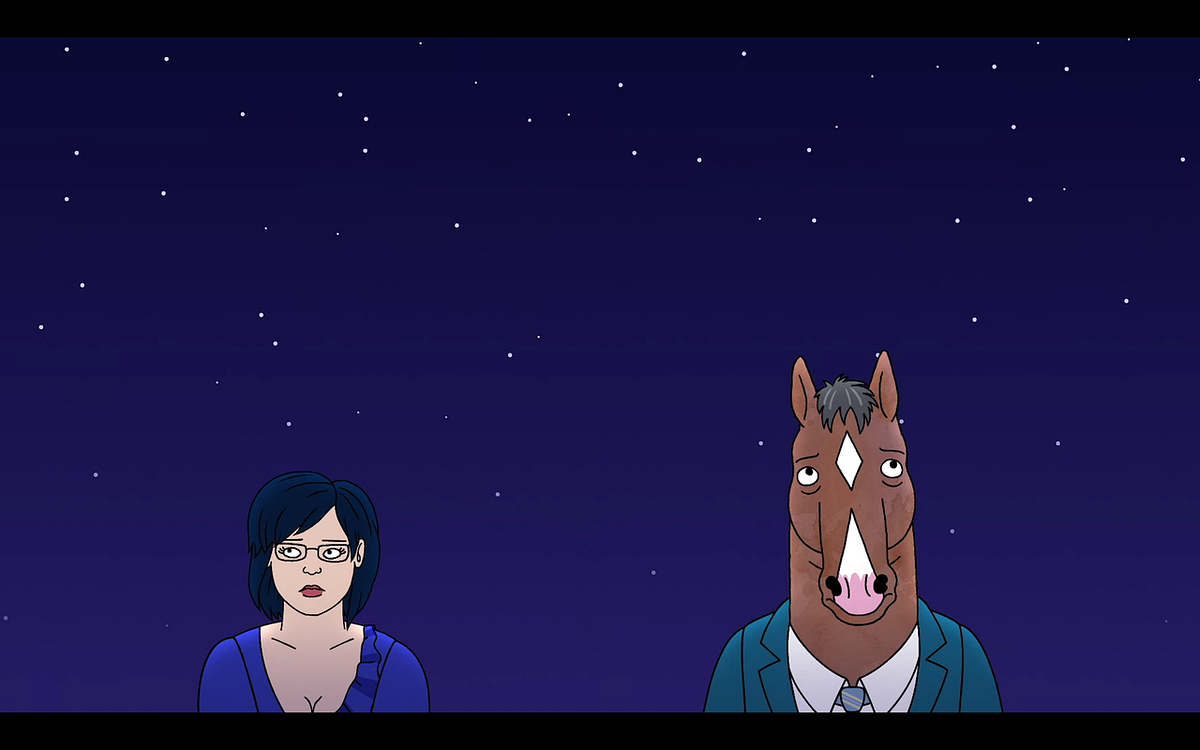
The series ends in silence as they sit on the roof, looking at stars, struggling to say something but choosing not to. The camera holds. Catherine Feeny’s “Mr. Blue” plays. Fade to black.
No resolution. No redemption arc. Just BoJack, sober (for now), with an uncertain future and everyone in his life having moved on. The show makes clear that permanent happy endings don’t exist.
viii. continuance
The temptation is fought. Not won, fought. By figuring out ways of atonement. Of making amends. Of doing right and hoping there’s some larger order that notices.
I started Berry House to offer my skills at low cost or free to people who need them. I understand this is self-flagellation. But I know, I know this is still just maladaptive behavior dressed up as altruism. That I’m trying to earn my way out of the hole by digging in a different direction.
But I don’t think there is a solution. There is just awareness. There is just continuance. There is just waking up and making the choice again. And again. And again.
Camus concluded that “the struggle itself towards the heights is enough to fill a man’s heart”. BoJack ends the series not healed or transformed, but simply on a path. Todd’s interpretation becomes profound: it’s not about the Hokey Pokey itself; it’s about “turning yourself around”. Every single day.
I will keep trying. Not because I’ve found The Answer or because the temptation has disappeared. The temptation is still there. The pit still drops in my stomach—that same hollowing, that same dark excavation I felt as a child watching my parents fight. Some weeks it’s just a tremor. Other weeks it’s the foundation shifting beneath me.
What’s changed is I’ve learned the difference between the pit and the void. The pit is something you live in. The void is something that swallows you whole.
I’m fat and alive and medicated. I chose, like Diane, to be happy about the weight gain because the alternative was being skinny and dead. I chose to go back on antidepressants despite knowing they’d change my body because my body doesn’t matter if I’m not in it. These aren’t triumphant choices. They’re just choices. Made again every morning. Sometimes every hour. Each time choosing the pit over the void.
The temptation of suicide offers relief from the burden of living. But relief is not the same as solution. Detachment is not the same as peace. The view from the rooftop is not the view from halfway down.
We must imagine BoJack continuing. We must imagine ourselves continuing. Not climbing out of the pit—maybe there is no climbing out. But continuing to exist within it. Learning which walls are load-bearing. Which corners catch the light. The struggle itself. The day after. The turning around. The keeping living. That’s all there is. That’s enough. That has to be enough. The pit remains. But so do I.
If you’re struggling with thoughts of suicide, please reach out. The 988 Suicide and Crisis Lifeline (call or text 988) provides 24/7, free and confidential support.
Comments
To comment, please sign in with your website:
How it works: Your website needs to support IndieAuth. GitHub profiles work out of the box. You can also use IndieAuth.com to authenticate via GitLab, Codeberg, email, or PGP. Setup instructions.
Signed in as:
No comments yet. Be the first to share your thoughts!