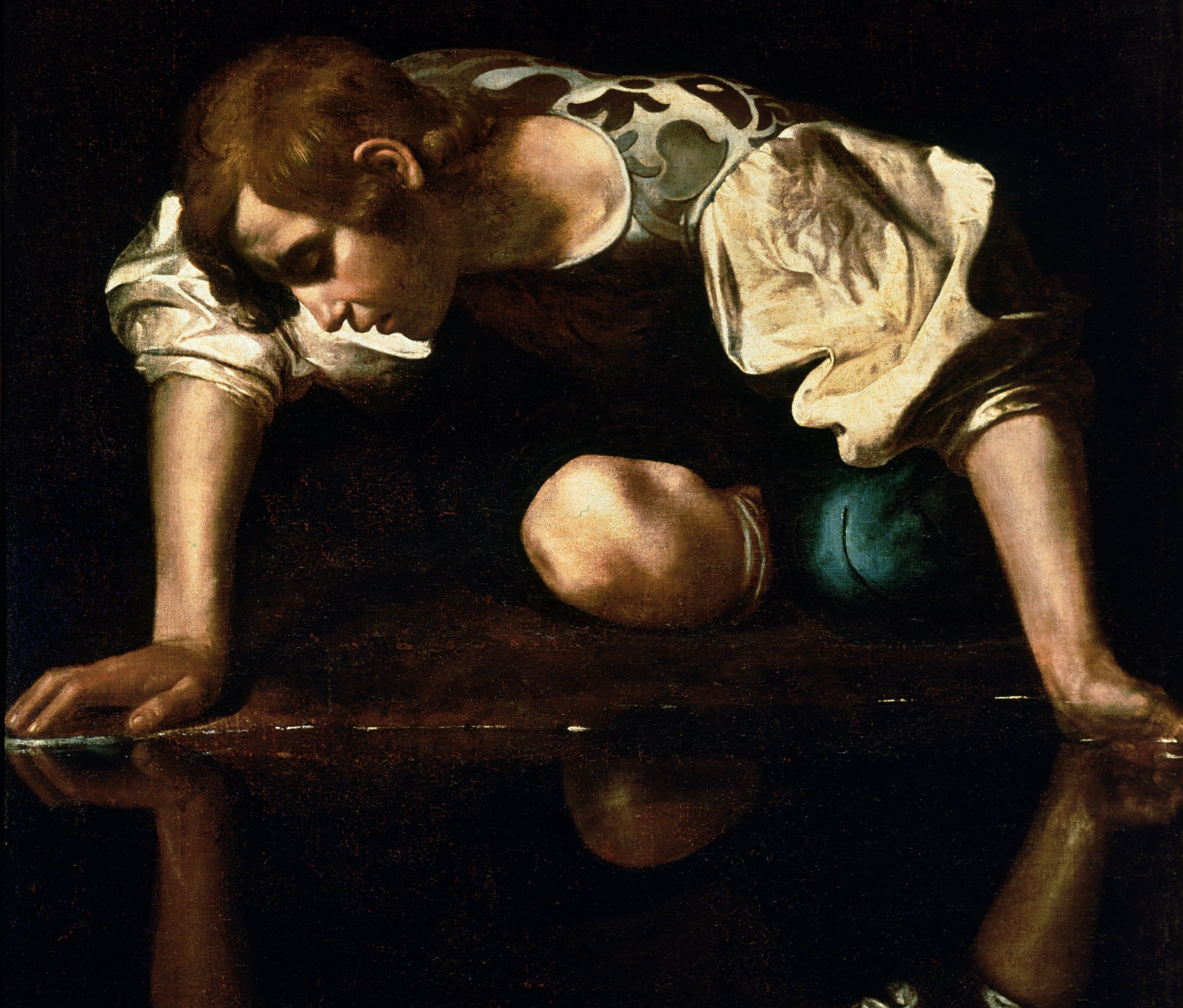
Caravaggio painting of Narcissus from 1594-96 | Source
AI Artists Have No Role Models
Now before I begin, I don't mean to preach to the choir here. Folks who already have an anti-AI sentiment do not need further discourse points on the harms and detriment of the current state of generative AI. No, this article is written in good faith for those who enjoy using AI, for those who would even go so far as to label themselves an AI artist, or perhaps just an AI-assisted artist.
You see, if you ask anybody who is pro-generative AI about their workflow, they will most likely passionately tell you about their back-and-forths with their AI model, which they most likely will humanize and anthropomorphize to an unsettling degree. Regardless of if they're an AI visual artist, an AI musician, an AI writer, there is a commonality shared. You'll hear about the technicalities, the switching between different models, the tweaking of prompts, but there is one thing you will not hear.
Their intake of AI-generated art. They will not be able to list off their influences in their field and medium of choice. In truth, they may even struggle to point to a single piece of AI-generated art that they enjoy.
It is difficult not to see this as an existential problem, right? I believe anybody with a rich, meaningful life can easily point to media that has shaped and pushed them into their passions. To go even further, I believe most people can easily point to media that has changed their life or who they fundamentally are as a person. This is human-made art. This has to be human-made art.
Viewing art increases blood flow in the brain by up to 10%. Equivalent to looking at someone you love. Art is shared experience between artist and audience that fundamentally changes us.
An artist and creator who is serious about their work, who enjoys their work, is somebody who greatly consumes the art created by others. Every form of media has role models, has influential creators that have shaped entire subcultures and the zeitgeist. The very concept of artistic lineage, which is defined as the historical and conceptual connections between artists across generations, is fundamental to understanding any creative field. Artists inherit/reinterpret/challenge the traditions of those who came before them, establishing a continuity of ideas, styles, and techniques. Artistic canon emerges from sustained attention across generations. Works that are repeatedly shown, written about, taught, and preserved.
The truth is that AI artists consume their own work only. They are no longer producing a line in this everlasting dialogue of culture that has been going on between all of us since the dawn of humanity. Human art serves as our only real means of communicating complex experiences. From 28,000-year-old cave paintings to contemporary works. Art is connection. The artwork becomes the ground where artists' intentions and audiences' responses meet. This contribution to our greater shared dialogue is severed, and in its place is a mirror. An echo. An ability to generate unlimited self-perpetuated "art" which is only possible due to the massive datasets containing the actual moving, meaningful work.
There is no longer a rich history, a lineage of artists that came before. There's no context and subjective interpretation which human artists bring to their work. AI-generated art cannot contribute to the ongoing artistic dialogue. Knowledge about a work's artificial origin consistently diminishes perceptions of its craftsmanship, emotional value, and aesthetic appreciation. There is no longer a future, either.
As I've already written about previously, AI data sets trained on AI data instead of human-made data deteriorate after only a few generations. This phenomenon, known as "model collapse," occurs when generative AI models are trained on synthetic data produced by other AI systems. Research published in Nature demonstrates that indiscriminate use of model-generated content causes irreversible defects in resulting models, where the tails of the original content distribution disappear. Synthetic data lacks wonderful, weird diversity found in the real-world, leading models to focus on common patterns and lose nuanced "long-tail" information crucial for continued improvement. AI-generated content proliferates online, scraped into more training datasets. Progress in the field will inevitably halt as a result.
Were we all to surrender and begin utilizing generative artificial intelligence the way the shareholders and technologists and transhumanists are begging and frothing at the mouth for us to do, it would only take a generation until the piss average mush becomes all we have. Eventually, there is no longer any variance in the data. In the place of art we find the fatal ouroboros, AI models train on data generated by previous AI models, causing them to drift further and further from reality. There will be nothing resembling something coherent or interesting, let alone meaningful and moving. A xerox of a xerox of a xerox.
Artists who do work in human-only spaces can list off so many different influences and role models. They can tell you stories of the first time they encountered artists and how their life changed in that moment. For me, when it comes to poetry, mine include Walt Whitman, T.S. Eliot, Emily Dickinson, e.e. cummings, William Carlos Williams, Robert Frost, Ezra Pound, Anne Sexton, Pablo Neruda, Seamus Heaney, Herbert Huncke, Lucien Carr, Gary Snyder, Neal Cassady, Bob Kaufman, LeRoi Jones, Allen Ginsberg, William S. Burroughs, Billy-Ray Belcourt, Jordan Abel, and Leonard Cohen. Just to name a few.
Meanwhile, prompt engineering communities share technical discourse for manipulating AI outputs, but these are fundamentally different from artistic movements or schools of thought. Prompt engineers learn the "grammar" and "vocabulary" of prompts. The technical specifications of comma usage, brackets for emphasis, and style keywords. They reference human artists by name to replicate their styles, parasitizing established artistic traditions rather than building new ones. Artist Karla Ortiz explains AI models can only generate what they've been instructed to generate based on the data given. The works, intellectual property, and private data of actual artists.
No matter how impressive and advanced generative models become, AI artists will never be able to list out their AI artists role models. There is no body of work to point to nor contribute to. AI art generates imagery based on datasets that do not include how memories, symbols, language, and cultures influence our organic neural networks. It will always just be the reflection, the answer will always just be themselves. This is why I think of the image of Narcissus at the lake. For it is so tempting and seductive to anybody who wants to skip having to immerse yourself into the work of others and listen to the dialogue before speaking. For it is so tempting and seductive to anybody who wants to skip the hard, difficult, painful experience of being shitty at something before they're good at it.
You will end up drowning, infatuated with your own reflection. Alone. The echo will fade.


_edited.jpg)
Comments
To comment, please sign in with your website:
How it works: Your website needs to support IndieAuth. GitHub profiles work out of the box. You can also use IndieAuth.com to authenticate via GitLab, Codeberg, email, or PGP. Setup instructions.
Signed in as: