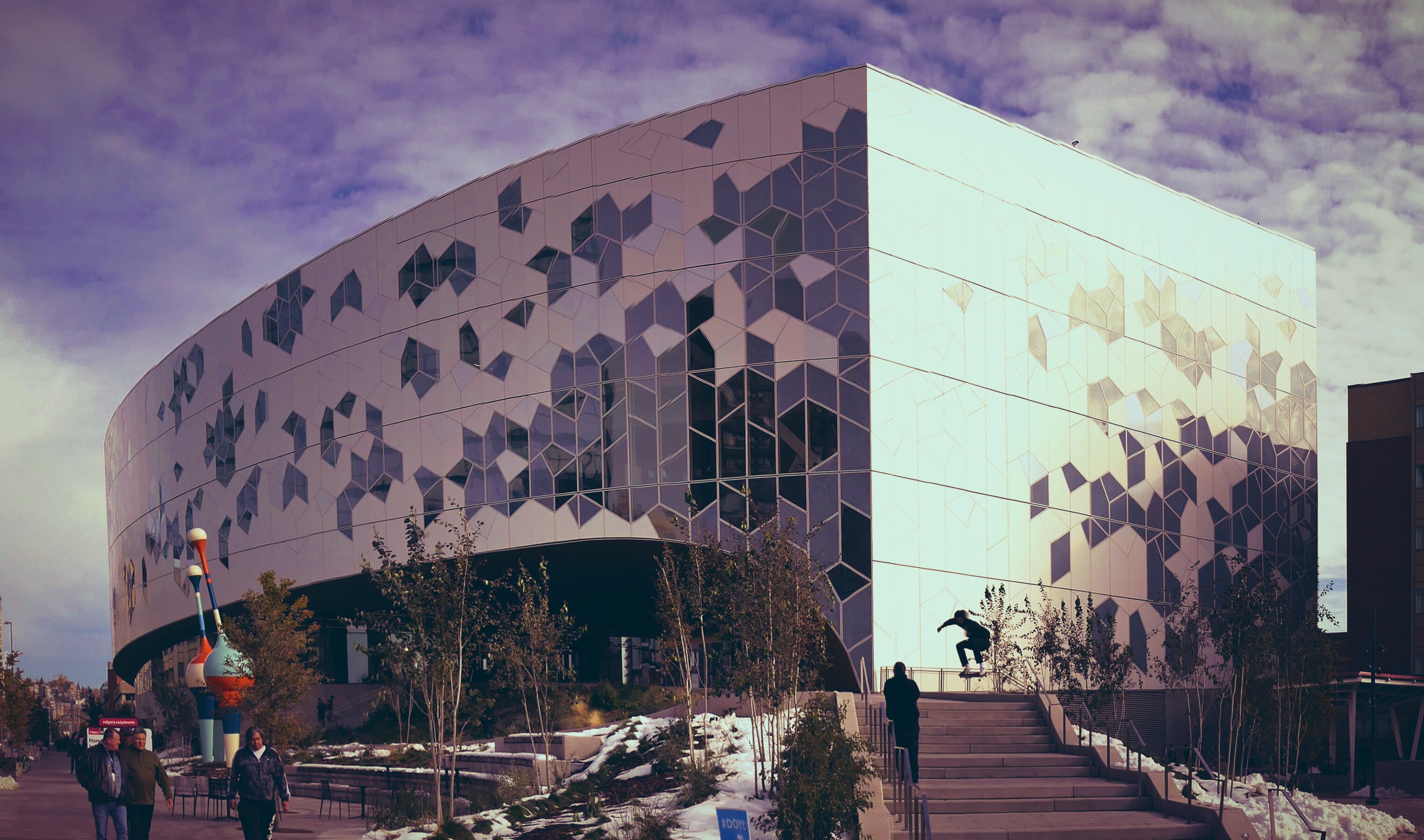
Source (edited by the Author)
Why is my local city and public library looking to pay $50/hr to an AI Artist Residency?

Around a week ago, Calgary's public library account on Instagram announced that they're looking for an "AI Collaborative Artist (AIC) 2026 at Calgary Public Library [for] a 10-week community engagement residency, from June 29 – September 4, 2026."
It certainly is a lucrative position, paying "$50/hr up to a total of 160 hours over the 10 weeks for a total of $8000" which "includes offsite preparation time and onsite program delivery time, including consultations and time to work on their stated project." This isn't even mentioning the new bizarre café in the library which has their assets, branding, and marketing ENTIRELY AI generated. I realized upon reading this that I needed to speak up and say something, regardless of how exhausted I am of anything generative AI at this point.
This Is Happening EVERYWHERE.
And this isn't the only AI Artist residency program. A province over has A Position on Retreat Artist Residency where artists would be working "[o]ver two weeks on Vancouver Island, with Dr. Brad Necyk" and by the end of it, they'll "leave with real, tangible work: a completed AI-generated short film or digital media project you're proud of."
In Winnipeg, the Harbour Collective and Video Pool Media Arts Centre have AI Mentorship Residency: Breaking the System which aims to give "BIPOC artists an opportunity to dive into the experimental side of AI." The Government of Quebec has a "Residency for Creation and Presentation in Arts and Artificial Intelligence".
Down in New York, Artiver has an AI Residency Program. There's also the online AI Hokusai ArtTech Research Project where artists "blend their unique artistic practices with cutting-edge tools like AI, VR, and new media". It goes on and on and on.
My initial measured, articulated thoughts are as follows: What the fuck is going on? I deeply struggle to try to understand and sympathize with any of these initiatives.
These public and private institutions are pouring funding into projects which are antithetical to the values of most artists. A 2024 survey of 459 artists published at the AAAI/ACM Conference on AI, Ethics, and Society found that 61% of artists consider generative AI a direct threat to the art workforce, and over 80% believe AI companies should be legally required to disclose which artworks were used to train their models. A separate survey found that 74% of artists consider the practice of scraping their work from the internet to train AI models to be outright unethical, while 89% say current copyright law offers them no meaningful protection. And, in case you were wondering: over 90% of artists view AI-generated work negatively, with zero respondents in that survey saying their view of a piece of art improved upon learning it was AI-generated. None. Not one.
No different from every tech company and startup shoving genAI into their products for the sake of making shareholders happy, there is no foresight here. No vision toward what end? Instead, we are left reading the ramshackle heartbreak of artists with righteous fury and melancholy in the comments section.
These art residencies normalize and legitimize genAI art. Does the artist produce better work? Are the commons and public better off for it? Do the elitist gatekeeping art collectors make more money? We are sacrificing our humanity at the gaping maw of silicone.
I do not know who is responsible for the decisions that lead to these initiatives, but again I deeply struggle to imagine these are artists working for the sake of other artists in good faith.
Fear of Missing Out (on destroying humanity)
Who is neurotically anxious and afraid of being left behind by not bending the knee to generative AI? What is being gained by going headfirst into this non-deterministic stochastic parrot of autocomplete?
The FOMO is poisoning us. We have been here before. During the NFT and Web3 boom of 2021–2022, institutions rushed to legitimize that technology the same way. VerticalCrypto Art's residency launched in July 2021, backed by the Tezos Foundation, billing itself as "the first ever online residency dedicated to Crypto Art and metaverse-natives." Voice ran multiple NFT residency cohorts throughout 2021 and 2022, earnestly framing blockchain as liberation for marginalized artists. Adidas launched its own NFT artist residency in 2023, dropping limited-edition Ethereum mints at Korea Blockchain Week. We know how that ended. The bubble popped, the "metaverse" became a punchline, and the artists who built their practices around those platforms were left holding the bag while the platforms collected the exit liquidity. The script is identical, the technology has changed.
There is nothing more lovely than seeing art in the public, whether that's a sanctioned mural or a simple graffiti tag. There is already such a small amount of money going into public art. And it's getting smaller. A 2025 report from the Canadian Chamber of Commerce found that while Canada's arts and culture sector contributed $65 billion to the economy, the federal government's allocation to arts and culture is "slipping" as a share of total spending, with grants facing "headwinds" while costs rise. The Canada Council for the Arts, our largest public arts funder, delivered $325.6 million to artists and organizations in 2023–2024, and is now facing potential cuts of $54 million as the federal government pushes for 15% reductions across Crown corporations. The grant acceptance rate at Canada Council has already fallen below 16%. The median individual income of a Canadian artist is $24,300 — 44% below the median for all Canadian workers, and below the low-income threshold for a single adult.
This is the climate in which our institutions are choosing to fund AI residencies. It makes me question if there is any money trading hands between genAI companies with their trillion-dollar valuations and these institutions. But that is pure conjecture on my part.
The Obvious Politics
Regardless of the reason why, or the logistics of the how, nothing good can come of programs like these. Everyone is worse off for it. The mental gymnastics and cognitive dissonance of those who disagree is no different than that of the insulated, radicalized politics of the aggressive new right-wing. It is simply impossible to decouple art from politics, and this is a great example of that.
So who is benefiting the most from artificial intelligence? Look south of the border. The Trump administration has fully embraced AI as a propaganda instrument. The White House and the Department of Homeland Security routinely post AI-generated videos and images on official government accounts. Poynter documented at least 14 such instances from official White House accounts alone, and 36 from Trump's personal Truth Social. We're talking about AI videos of Trump as king, pope, Superman, and Jedi; AI footage of him flying a fighter jet and dumping feces on protesters; AI-altered images of political opponents depicting them weeping or in racist caricature. The White House's response to criticism? "The memes will continue." This is the world that is being built by the normalization of AI as a creative and communicative medium. Our libraries and arts councils are handing it a residency.
What Can We Do?
If you live in Calgary, you can voice your concerns directly:
Library foundation number: 403-221-2002
Calgary public library number: 403-260-2600
If you live elsewhere, check what your local art programs and initiatives are funding, both publicly and privately.
The artists who make our public spaces worth inhabiting. Those who paint the murals, play the cafés, run the workshops, write the poems that end up taped to transit windows. Artists already working at or below the poverty line, competing for grants with a 16% success rate, watching their funding get cut while inflation eats their studio rents. These are the people our institutions are supposed to serve. Instead, a library that can't afford to properly pay its human artists in residence is offering $8,000 to legitimize a technology that the overwhelming majority of those same artists say threatens their livelihood.
There is no version of this that is neutral. Every dollar directed toward normalizing AI art generation is a dollar that didn't go toward a muralist, a poet, a filmmaker, a ceramicist. A person who has spent years building a practice and a relationship with their community. Every institutional stamp of approval on this technology makes the next round of cuts to human artists that much easier to justify.
Art is not a problem to be optimized. It is the record of what it felt like to be alive here, in this body, in this city, on this particular frozen block of Treaty 7 territory. No model trained on scraped images can produce that. The FOMO will pass. It did with blockchain. It will with this. But the damage to underfunded arts ecosystems, to the trust between institutions and the communities they claim to serve? That lingers.
Write the email. Make the call. Don't let this continue.
Comments
To comment, please sign in with your website:
How it works: Your website needs to support IndieAuth. GitHub profiles work out of the box. You can also use IndieAuth.com to authenticate via GitLab, Codeberg, email, or PGP. Setup instructions.
Signed in as:
No comments yet. Be the first to share your thoughts!