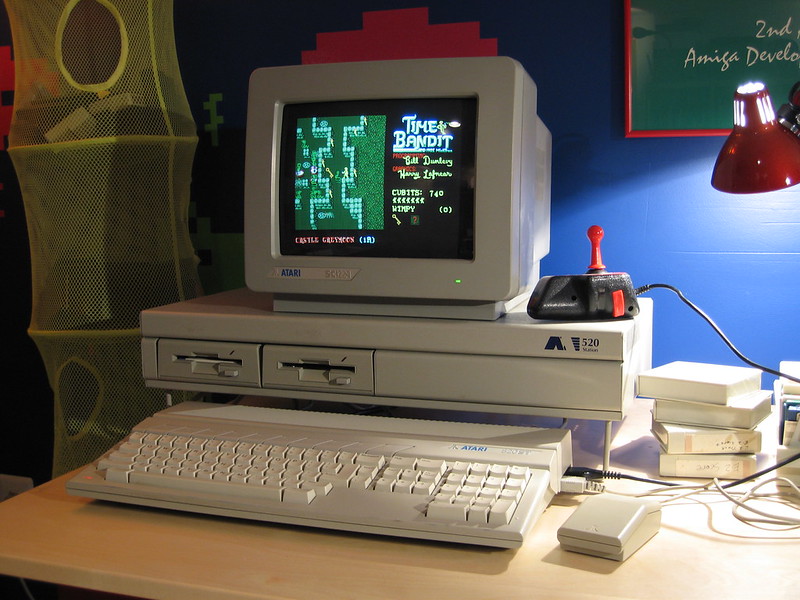
Atari 520ST system as it was with the lesser SC1224 (Goldstar) screen
Choosing Quiet: I'm No Longer Using AI Editors

To have cognitive dissonance about our ethics and day-to-day actions is to be sane. Surely, this is the case. How else are we supposed to function in a world that has such immense suffering and with our own comfort and existence feels often as though it comes at the cost of others' suffering?
I see countless people, people who think they're morally good, who compartmentalize well. Pet owners that would die for their dog or cat but doesn't bat an eye at eating a similarly emotionally-intelligent mammal such as a pig or a cow. Animals that are capable of feeling pain and suffering, animals who deserve the same amount of time and living as the pets in question. Research has shown that pigs share cognitive capacities with dogs, chimpanzees, elephants, and dolphins, exhibiting emotional contagion, self-awareness, and complex social behaviours.
Please, don't get me wrong. This isn't finger-wagging or pearl-clutching. I am not gnashing my teeth at meat eaters, I know that isn't effective rhetoric. People are never convinced by this modailty of dialogue. Much more importantly, though, I sincerely do not think these are bad people. We take stock of it all, we figure out what's worth the cost and sacrifice. What juice is worth the squeeze?
I bring up this example to make a (perhaps somewhat awkward) parallel to people's stances on AI* (I mean token-based large language models when I say AI). AI harms and creates suffering, though I do need to concede it has (on record) killed less than two dozen people,
Regardless, I think it is a helpful parallel because the same cognitive dissonance can occur. I tell myself I only use AI for gruntwork, That if I treat it like a utility and a tool instead of a bizarre messianic replacement for my original human thoughts that it is not a big deal.
But it is still a big deal, isn't it? AI is causing RAM shortages, AI is taking all of our land, water, and energy. These are not problems to hand-wave away. A typical data center uses 300,000 gallons of water each day, with large facilities consuming up to 5 million gallons daily --- equivalent to the needs of a town of 50,000 residents. By 2027, global AI demand could account for 1.1 to 1.7 trillion gallons of water withdrawal, more than four to six times Denmark's total annual water usage. Meanwhile, data centers consumed 4.4% of U.S. electricity in 2023, a number that could triple by 2028, with AI systems potentially generating carbon emissions equivalent to New York City in 2025 alone.
There are compelling arguments to not use AI whatsoever that have nothing to do with the existential problems or ethical concerns as well. AI gives us convenience, gives us expedited process. There is a saying that only dead fish find themselves swimming the path of least resistance.
I have become fatigued with how easy everything has become. The grit and friction are not to be avoided. The waiting, the legwork, the delayed gratification. I want to be able to pass the marshmallow study. We owe this to ourselves, to attempt to live life rather than shortcut it.
For, what is the shortcut for? Why do we want to work faster? To do more work later? If you're doing a job you disdain and that requires a lot of energy, I think it's ethical to put the bare minimum in then, but again, this is a personal passion project of mine. Why would I want to rush?
I think an answer to that is how I focus and fixate easily. Perhaps this can be explained with a particular undiagnosed neurodivergence, if I wanted to pathologize it.
Since October, I had been writing a 3,000-word article on my Medium blog nearly every day and continued this until the middle of December. I rarely did any coding and, funnily enough, told myself that I would probably not code again. In the moment, I feel such an intense love for the act of writing that it seems none of my other interests could ever take the limelight again.
But then, a week or two ago, I stumbled upon omg.lol and quickly became re-obsessed with the IndieWeb and coding again. To give yet another attempt at creating my own personal site from scratch. The focus and fixation shifted once again for me. The lovely part about this, though, is I write detailed dev logs such as this so I still continue the practice of writing when I get re-obsessed with code, but it is a lot different; the writing is not the focus.
All of that is to say that I think in the time when I find myself obsessed, I want to work fast because I feel as though there's so much I want to work on. So I delegate a lot of work to the AI-assisted IDE to sprint. And luckily I have enough experience and know-how (and admittedly, because I'm using simple front-end only technologies) that no existential bugs or bad code hygiene arises from this.
Well, that's not true. The stylesheet of my simple static 11ty blog is nearly 3,000 lines long. But that isn't the fault of AI. I would have gotten to 3,000 lines of CSS myself because I'm not using any frameworks (or even SCSS or SASS or LESS) and I'm neurotic about design. It was just a lot faster.
An argument can be made for speed, in that sometimes you just need to sprint to get something started. This is the ethos of game jams and hackathons. But those have always been purely human prior to 2020 because all we had was the pure human.
You see? The cognitive dissonance is seductive. I'm smart enough to formulate apologetics for taking actions that violate my internal value system, just like everyone else. Nearly everything can be painted as mostly harmless, and that is one of our greatest, most dangerous threats. But that ends here for me. If I don't eat meat, why would I be okay with using AI at all?
Plus, I think it would just be a fun challenge to go full Luddite for 2026. To return to a form of holistic human thought. And perhaps there's something to embrace here. Research shows that "desirable difficulties," which are learning conditions that feel challenging but enhance long-term retention, actually produce stronger, more durable learning than easy, frictionless study. While difficult tasks might slow learning initially, the long-term benefits are far greater than taking the path of least resistance.
In The Weeds
Okay, that was a lot of philosophical preamble. Let me begin my process back towards an AI-free coding experience. At first, I thought I would simply return to VS Code, since that was my editor of choice prior to Windsurf (which is just a fork of VS Code anyways).
But if you go to the homepage of VS Code now, you'll see it's now branded as "The open source AI code editor" by Microsoft, and suddenly the text editor had an identity. An agenda. A monetization strategy wrapped in the language of developer productivity.
Microsoft ought to be boycotted, anyways.
So, where am I writing my code now? I decided to return to the much more simple Sublime Text. I will have to get used to how minimal it is compared to VS Code, get used to the package controller and lack of built-in terminal or git intergration.
And I am so lucky and grateful for this. That there's still a functioning IDE out there that I can use that isn't desperately trying to be AI-first, or have any sort of generative LLM built-in at all.
Shareholders would call this a disaster, would say that Sublime Text is leaving massive amounts of money on the table and bleeding their userbase by not having "AI" anywhere on their homepage. Good, fuck the shareholders.
I've lost instant boilerplate generation, refactoring suggestions, the hit of dopamine that comes with hitting tab and watching 10 lines of code spontaneously appear. But I've also lost the creeping feeling of being watched and analyzed. The gnawing feeling that I'm doing somethng deeply wrong. I'm thinking slowly again. I own everything here, creating it all on my own.
My Current Setup
For anyone else considering this transition, here's what I'm running:
- Sublime Text 4 (no AI, just a damn good editor)
- LSP packages for TypeScript, JSON, CSS (real language servers, not LLMs)
- Terminus (integrated terminal)
- Markdown Extended + MarkdownPreview (for these blog posts)
- Tailwind CSS Autocomplete (still autocomplete, but rule-based, predictable)
- Nunjucks Syntax (for Eleventy templates)
This isn't actually about Sublime Text vs. Windsurf vs. VS Code. It's about the right to think for ourselves. To struggle. To be inefficient in order to learn properly.
The IndieWeb movement talks a lot about content and platform ownership. There, too, needs to be ownership of the process.
I'm writing this post in Sublime Text right now. A nice gruvbox theme, size-13 Andale Mono. The world is frosted outside and a new year is upon us. I feel like I'm coming home.

Comments
To comment, please sign in with your website:
How it works: Your website needs to support IndieAuth. GitHub profiles work out of the box. You can also use IndieAuth.com to authenticate via GitLab, Codeberg, email, or PGP. Setup instructions.
Signed in as:
No comments yet. Be the first to share your thoughts!